



I MAKE A NEW BOAT (я мастерю новую лодку)
I MADE up my mind to begin the new boat at once (я решил начать /строить/ новую лодку).
So, the next day (поэтому, на следующий день), I went with Friday to find a good tree (я отправился с Пятницей найти хорошее дерево).
There were trees enough on the island to build a fleet (на острове было достаточно деревьев, чтобы построить флот). But, I must find one that was close to the water (но я должен был найти такое, что было близко к воде), so that we could launch the boat when it was made (чтобы мы смогли спустить лодку на воду, когда она будет готова; to launch — спускать судно на воду).
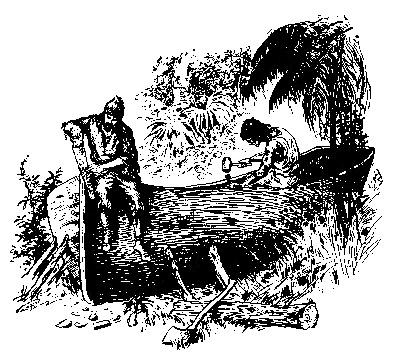
At last Friday found one (наконец Пятница нашел /такое/ дерево). He knew, better than I (он лучше меня знал), what kind of wood was best for making a boat (какой вид дерева был лучшим для создания лодки).
It was an odd-looking tree (это было странное: «странно выглядящее» дерево; odd — нечетный; чуждый, необычный, странный), and to this day I do not know its name (и по сей день я не знаю его названия).
Friday chopped it down (Пятница срубил его). He cut off a part of it for the boat (он отрубил часть его для лодки).
He wished to build a fire on the top of it (он захотел разжечь огонь на его верхней части) and thus burn out the hollow part of the boat (и таким образом выжечь полую часть лодки).
But I showed him a better way (но я показал ему лучший способ = способ получше), to chop it out with hatchets and chisels (/что можно/ выдолбить его /бревно/ топориками и долотом).
In about a month it was finished (примерно через месяц она /лодка/ была закончена). With our axes (нашими топорами) we cut and hewed the outside till it was in a very good shape (мы резали и рубили наружную часть, пока она не приняла очень хорошую форму).
Then we worked hard for two weeks to get the boat into the water (затем мы тяжело трудились в течение двух недель, чтобы доставить лодку в воду).
But when she was in (но когда она оказалась в воде), how well she floated (как хорошо она поплыла)! She would have carried at least twenty men (она могла бы везти самое малое двадцать человек).
It was wonderful (было удивительно) how well Friday could manage her (как хорошо Пятница мог управлять ею). It was wonderful how fast he could paddle (как быстро он мог грести).
"Now, Friday (а теперь, Пятница)," I said, "do you think she will carry us over the sea (как ты думаешь, она перевезет нас через море)?"
"Yes, master," he said, "she will carry us even in the worst wind (даже при самом худшем ветре)."
My next care was to make a mast and a sail (моей следующей заботой было сделать мачту и парус), and to fit the boat with an anchor and a rudder (и оборудовать лодку якорем и рулем).
It was easy enough to get the mast (было довольно легко раздобыть мачту). I had Friday cut down a tall young cedar (я приказал Пятнице срубить высокий молодой кедр; to cut — резать; рубить, валить /лес/; to cut down — рубить /деревья/) that grew near the place (который рос неподалеку: «близко к этому месту»).
He shaped it and smoothed it (он придал ему форму и сровнял), and made as pretty a mast as you would wish to see (и сделал такую красивую мачту, какую бы вы /только/ хотели видеть = что лучше некуда).
As for the sail, that was another thing (что касается паруса, это было другое дело). I had old sails (у меня были старые паруса), or pieces of old sails (или = точнее, куски старых парусов) in plenty (в изобилии: «в полноте»).
But they had been lying in this place and in that for six and twenty years (но они лежали то тут, то там в течение двадцати шести лет). It would be a wonder if they were not all rotten (было бы чудом, если бы они не оказались все гнилыми).
After a long search (после долгих поисков) I found two pieces which I thought would do (я нашел два куска, которые, как я подумал, подойдут). I set to work, patching and stitching (я взялся за работу, за латание и шитье; to stitch — шить; стегать).
It was slow work without needles (это была медленная работа — без иголок), you may be sure (можете быть уверены = как вы понимаете).
At last I had a three-cornered (наконец у меня была треугольная), ugly thing (уродливая штука).
I had also a little short sprit (у меня был также маленький короткий шпринтов10) to run up at the top of the mast (идущий на верхушку мачты).
It took two months (заняло два месяца) to make the sails and the rigging (чтобы изготовить паруса и оснастку) as I wished (такими, как я желал).
Then I put in a rudder to steer the boat (затем я установил руль, чтобы направлять лодку). I was a poor carpenter (жалкий из меня был плотник), and I made a pretty rough job of it (и моя работа была довольно грубой).
Friday knew how to paddle a canoe as well as any man (Пятница умел грести на каноэ не хуже любого = прекрасно умел грести).
But he knew nothing about a sail (но он ничего не знал о парусе). He had never seen a boat steered by a rudder (он никогда не видел лодку, управляемую рулем).
We made several little voyages near the island (мы проделали несколько маленьких поездок возле острова) and I taught him how to manage everything about the boat (и я обучил его, как управляться со всем, что в лодке).
Much as I wished to go back to my own people (как бы я ни хотел вернуться к своим соотечественникам), I could not make up my mind (я не мог решиться) to try the long voyage across to the mainland (попробовать долгое путешествие на ту сторону, к материку).
I had now been on the island twenty-seven years (я был на острове уже двадцать семь лет). My man Friday had been with me about two years (мой слуга Пятница был со мной около двух лет), and these had been the happiest of my life (и эти /два года/ были самыми счастливыми из = в моей жизни). I had everything to make me comfortable and happy (у меня было все, чтобы сделать меня удовлетворенным и счастливым; comfortable — уютный, удобный; спокойный, довольный).
Why should I wish to go away (почему я должен хотеть уехать)?
I had a great longing (у меня было большое желание) to see my native land again (увидеть снова мою родную землю), to talk with people of my own race (поговорить с людьми моей собственно расы), perhaps to visit my kindred once more (возможно, посетить еще раз моих родственников). This longing I could not rid myself of, day or night (от этого желания не мог я избавиться ни днем, ни ночью; to get rid of smth. — избавиться от чего-л.).
But now new thoughts came into mind (но теперь новые мысли приходили на ум). I felt that in some way I would soon escape from the island (я чувствовал, что так или иначе я скоро убегу с острова; to escape — совершать побег, спасаться). Indeed, I was quite sure that I would not stay there another year (на самом деле, я был вполне уверен, что я не останусь здесь еще на год).
I cannot tell you what made me feel that way (я не могу сказать вам, что заставило меня чувствовать так). But I seemed to know that some great change in my life was near at hand (но я, казалось, знал, что какое-то большое изменение в моей жизни было близко).
Yet I went on with my farming as before (все же/однако я продолжал фермерство, как раньше). I dug (я копал), I planted (сажал), I reaped (жал; to reap — жать, пожинать, собирать урожай), I gathered my grapes (собирал виноград), I did everything just as though I had no such thoughts (я делал все точно так, как будто у меня не было таких мыслей).
My man Friday was the truest of helpers (мой слуга Пятница был самым преданным из помощников; true — верный, правильный; должный, надлежащий; верный, преданный: a true friend — преданный друг). He did all the heavy labor (он делал = брал на себя весь тяжелый труд). He would not let me lift my hand (он не позволял мне поднять руку) if he could help it (если только мог /сделать это/).
The rainy season at last came upon us (наконец наступил: «пришел на нас» сезон дождей: «дождливый сезон»), and this put an end to most of our outdoor work (и это прекратило = заставило нас прекратить большую часть нашей работы вне дома).
We took our new boat to a safe place some distance up the little river (мы отвели нашу новую лодку в безопасное место на некоторое расстояние вверх по речке), above the point (выше того места; point — точка; место) where I had landed my rafts from the ship (где я /когда-то/ причаливал со своими плотами /во время плаваний/ от корабля).
We hauled her up to the shore at high-water mark (мы затащили ее на берег у отметки высокой воды; high-water mark — уровень полной воды; максимальный уровень подъема воды), and there Friday dug a little dock for her (и там Пятница вырыл небольшой док11 для нее).
This dock was just big enough to hold her (этот док был как раз достаточно велик = был велик именно настолько, чтобы вмещать: «держать» ее) and it was just deep enough to give her water to float in (и настолько глубок, чтобы давать ей воду, в которой /она могла/ держаться на плаву).
When the tide was out (когда был отлив) we made a strong dam across the end of it (мы соорудили крепкую дамбу через конец /дока/), to keep the water out (чтобы не пускать воду; to keep out/off — не допускать, не впускать; не позволять). Thus she lay high and dry on the bank of the river (так она лежала вытащенной на берегу реки; high and dry — вытащенный на берег /о судне/: «высоко и сухо»).
To keep the rain off (чтобы предохранить /ее/ от дождя: «чтобы не пускать дождь») we laid a great many branches of trees upon her till she was covered thickly with them (мы положили на нее много веток деревьев, пока она не стала ими укрыта очень плотно). A thatched roof (крытая соломой крыша; thatch — солома, тростник /как материал для кровли крыши/; to thatch — крыть соломой/тростником) could not have protected her better (не могла бы защитить ее лучше).
Little did I think that I should never see our boat floating upon the water again (мало я /тогда/ задумывался над тем, что никогда больше не увижу нашу лодку вновь на плаву). For all that I know (я могу лишь предположить), she is still lying high and dry in her little waterproof dock (что она все еще лежит вытащенной на берег в своем маленьком, не пропускающем воду доке; waterproof — водонепроницаемый, непромокаемый; водоотталкивающий; водостойкий, водоупорный).
We were now kept indoors a great part of the time (мы держались = проводили теперь внутри/в доме большую часть времени; to keep — держать, не отдавать; держаться, сохраняться; оставаться /в известном положении, состоянии/; /разг./ жить: where do you keep? — где вы обретаетесь?), but we kept ourselves occupied pleasantly (но мы были приятно занятыми), and the hours passed swiftly (и часы проходили быстро).
My first duty every morning (моей первой обязанностью каждое утро; duty — долг, обязательство) was to read several chapters from the Bible (было читать несколько глав из Библии). Then I instructed Friday in some of the truths of religion (затем я наставлял Пятницу в некоторых религиозных истинах).
I was but an awkward teacher (я был всего лишь неловким учителем), but I did my best (но я старался/делал все возможное: «делал мое лучшее») and was honest (и был честным = добросовестным).
I began by asking him about the Creator (я начал с того, что задал ему вопрос о Создателе; to create — создавать, творить).
I asked him who made the sea, the hills, the woods (я спросил его, кто сделал море, холмы, лес), the ground we walked on (землю, по которой мы ходим).
He told me it was one great being who lived beyond all (он сказал мне, что это было великое существо, которое жило вне пределов всего).
I confess (я признаюсь) I could not have given a better answer (я не мог бы дать лучшего ответа).
He said that this great being was older than the sea or the land, the moon or the stars (он сказал, что это великое существо было старше моря и: «или» суши, луны и звезд).
Then I said (затем я сказал), "If this being has made all things (если это существо сделало все вещи), why do not all things worship him (почему все вещи не почитают его)?"
He looked very grave (он выглядел очень серьезным = принял серьезный вид; grave — важный, степенный, серьезный), and with eyes full of innocence (и с глазами, полными невинности), answered, "All things say O to him (все вещи говорят ему «О»)."
Thus he taught me while I was trying to teach him (так он учил меня, в то время как я пытался учить его).
rudder ['rAdq], cedar ['si:dq], carpenter ['kQ:p(q)ntq], pretty ['prItI], rough [rAf], kindred ['kIndrqd], haul [hO:l], occupy ['OkjupaI], pleasantly ['plezntlI], awkward ['O:kwqd], Creator [krI'eItq], worship ['wq:SIp], innocence ['Inqs(q)ns]
I MAKE A NEW BOAT
I MADE up my mind to begin the new boat at once.
So, the next day, I went with Friday to find a good tree.
There were trees enough on the island to build a fleet. But, I must find one that was close to the water, so that we could launch the boat when it was made. At last Friday found one. He knew, better than I, what kind of wood was best for making a boat.
It was an odd-looking tree, and to this day I do not know its name.
Friday chopped it down. He cut off a part of it for the boat.
He wished to build a fire on the top of it and thus burn out the hollow part of the boat.
But I showed him a better way, to chop it out with hatchets and chisels.
In about a month it was finished. With our axes we cut and hewed the outside till it was in a very good shape.
Then we worked hard for two weeks to get the boat into the water.
But when she was in, how well she floated! She would have carried at least twenty men.
It was wonderful how well Friday could manage her. It was wonderful how fast he could paddle.
"Now, Friday," I said, "do you think she will carry us over the sea?"
"Yes, master," he said, "she will carry us even in the worst wind."
My next care was to make a mast and a sail, and to fit the boat with an anchor and a rudder.
It was easy enough to get the mast. I had Friday cut down a tall young cedar that grew near the place.
He shaped it and smoothed it, and made as pretty a mast as you would wish to see.
As for the sail, that was another thing. I had old sails, or pieces of old sails in plenty.
But they had been lying in this place and in that for six and twenty years. It would be a wonder if they were not all rotten.
After a long search I found two pieces which I thought would do. I set to work, patching and stitching.
It was slow work without needles, you may be sure.
At last I had a three-cornered, ugly thing.
I had also a little short sprit to run up at the top of the mast.
It took two months to make the sails and the rigging as I wished.
Then I put in a rudder to steer the boat. I was a poor carpenter, and I made a pretty rough job of it.
Friday knew how to paddle a canoe as well as any man.
But he knew nothing about a sail. He had never seen a boat steered by a rudder.
We made several little voyages near the island and I taught him how to manage everything about the boat.
Much as I wished to go back to my own people, I could not make up my mind to try the long voyage across to the mainland.
I had now been on the island twenty-seven years. My man Friday had been with me about two years, and these had been the happiest of my life. I had everything to make me comfortable and happy.
Why should I wish to go away?
I had a great longing to see my native land again, to talk with people of my own race, perhaps to visit my kindred once more. This longing I could not rid myself of, day or night.
But now new thoughts came into mind. I felt that in some way I would soon escape from the island. Indeed, I was quite sure that I would not stay there another year.
I cannot tell you what made me feel that way. But I seemed to know that some great change in my life was near at hand.
Yet I went on with my farming as before. I dug, I planted, I reaped, I gathered my grapes, I did everything just as though I had no such thoughts.
My man Friday was the truest of helpers. He did all the heavy labor. He would not let me lift my hand if he could help it.
The rainy season at last came upon us, and this put an end to most of our outdoor work.
We took our new boat to a safe place some distance up the little river, above the point where I had landed my rafts from the ship.
We hauled her up to the shore at high-water mark, and there Friday dug a little dock for her.
This dock was just big enough to hold her and it was just deep enough to give her water to float in.
When the tide was out we made a strong dam across the end of it, to keep the water out. Thus she lay high and dry on the bank of the river.
To keep the rain off we laid a great many branches of trees upon her till she was covered thickly with them. A thatched roof could not have protected her better.
Little did I think that I should never see our boat floating upon the water again. For all that I know, she is still lying high and dry in her little waterproof dock.
We were now kept indoors a great part of the time, but we kept ourselves occupied pleasantly, and the hours passed swiftly.
My first duty every morning was to read several chapters from the Bible. Then I instructed Friday in some of the truths of religion.
I was but an awkward teacher, but I did my best and was honest.
I began by asking him about the Creator.
I asked him who made the sea, the hills, the woods, the ground we walked on.
He told me it was one great being who lived beyond all.
I confess I could not have given a better answer.
He said that this great being was older than the sea or the land, the moon or the stars.
Then I said, "If this being has made all things, why do not all things worship him?"
He looked very grave, and with eyes full of innocence, answered, "All things say O to him."
Thus he taught me while I was trying to teach him.
I SEE A STRANGE SAIL (я вижу незнакомый парус)
I PASS over some wonderful things that happened during my last year on the island (я пропускаю некоторые удивительные вещи, которые произошли в течение последнего моего года на острове). For I must not make this story too long (так как я не должен делать эту историю слишком длинной).
I was fast asleep in my castle one morning when Friday came running in (я крепко спал в моем замке одним утром, когда Пятница вбежал: «прибыл бежащим» внутрь).
"O master, master (о хозяин)!" he cried (прокричал он), "a boat, a boat (лодка)!"
I jumped up (я вскочил) and went out as quickly as could (и вышел так быстро, как мог). I was in such haste (я был в такой спешке) that I forgot to carry my gun with me (что забыл взять с собой ружье).
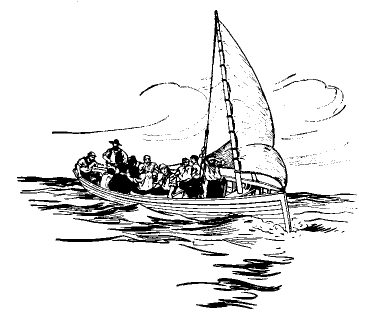
I looked toward the sea (я взглянул на море). About three miles from the shore I saw a strange boat coming to the island (примерно в трех милях от берега я увидел чужую лодку, плывущую к берегу). It carried a leg-of-mutton sail (на ней был треугольный парус: «она несла треугольный парус»; leg-of-mutton sail — треугольный парус: «парус ‘нога барана’») and was coming swiftly with the wind (и быстро подплывала, идя по ветру). "Surely (конечно/несомненно)," I thought, "this is not the kind of boat that savages sail in (это не того рода лодка, в каких плавают дикари)."
Then I saw that it was coming not from the open sea on my side of the island (затем я увидел, что она приближается не со стороны открытого моря на моей стороне острова), but from around a point on the south shore (а вокруг мыса на южном берегу).
I ran back to my castle (я побежал обратно в замок) and told Friday to stay inside and keep quiet (и сказал Пятнице оставаться внутри и сидеть тихо: «держаться/сохраняться тихо») till we could learn whether the people in the boat were friends or foes (пока мы не узнаем, были ли люди в лодке друзьями или врагами).
Then I climbed up to my lookout on the top of the great rock (затем я забрался на мой наблюдательный пункт на вершине большой скалы).
I looked out toward the south shore (я посмотрел в сторону южного берега), and there I saw a ship lying at anchor (и увидел там корабль, стоящий: «лежащий» на якоре). As nearly as I could guess (насколько я мог прикинуть; to guess — гадать, догадываться; полагать, считать), it was about five miles from my castle (он был примерно в пяти милях от моего замка) and at least three miles from the shore (и самое малое в трех милях от берега).
It looked just like an English ship (он выглядел в точности как английский корабль), and the boat was surely an English longboat (и лодка была несомненно английским баркасом12).
I cannot tell you how glad I was at the thought (я не могу передать вам, как счастлив я был при мысли) that some of my own countrymen were so near (что некоторые из моих соотечественников были столь близко). Yet I felt strange fears (и все же я почувствовал странные страхи), and so made up my mind to be very cautious (и потому принял решение быть очень осторожным).
In the first place, what business could an English ship have in these seas (прежде всего, какие дела могли быть у английского корабля в этих морях)? The English had no lands in this part of the world (у англичан не было никаких земель = владений в этой части света). They would not come here to trade (они не могли прибыть сюда для торговли). There had been no storms to drive the vessel to this place (не было /и/ штормов, чтобы пригнать судно в это место).
The more I thought of the matter (чем больше я думал об этом: «об этом предмете/об этой материи»), the more I doubted (тем больше я сомневался). If these people were indeed English (если эти люди в самом деле были англичанами), they must be here for no good purpose (они, должно быть, были здесь с недоброй целью).
By this time the boat was quite near the shore (к этому времени лодка была /уже/ довольно близко от берега). I could see the men in it quite plainly (я мог рассмотреть людей/экипаж в ней достаточно ясно). They looked like Englishmen (они выглядели как англичане).
As they came in the tide was at its highest (когда они подплыли, прлив был в своей высшей точке: «при своем самом высоком»), and so they ran the boat far up on the beach (и поэтому они причалили лодку далеко вверх по береговой полосе; to run up — подъезжать, подходить, подплывать) about half a mile from me (примерно в полумиле от меня).
I now counted eleven men (я насчитал одиннадцать человек), and all but three were armed with swords (и все, кроме троих, были вооружены шпагами). As soon as the boat touched the land (как только лодка коснулась берега), the most of them jumped out (большинство из них выскочили из нее).
Then I saw that the three unarmed men were prisoners (затем я увидел, что три невооруженных человека были пленниками). Their hands were tied behind them (их руки были связаны за спиной: «за ними») and they were closely guarded (и они были под строгой охраной: «внимательно охранялись»; closely — близко; вплотную; внимательно, тщательно).
As they were led on shore (когда они были выведены на берег; to lead — вести), they seemed in great distress (они, казалось, были в большом горе = в отчаянии; distress — горе, несчастье, душевное страдание; бедственное положение) as though begging for their lives (словно прося за свои жизни = сохранить им жизнь).
When Friday saw all this (когда Пятница увидел все это), he cried out to me (он крикнул мне), "O master! the white mans do just like savage mans with their prisoners (белые люди поступают точно так же, как дикари со своими пленниками; mans — неправильная форма мн. числа /правильная — men/)."
"Why, Friday (да ну, Пятница; why — почему?; выражает самые разнообразные эмоции в зависимости от контекста: удивление, согласие или несогласие, нетерпение и т. п.)," I said, "do you think they are going to eat them (ты думаешь, что они собираются съесть их)?"
"Yes, yes," he answered (ответил он), "they are going to eat them."
The prisoners were led far up on the beach (пленники были проведены далеко вверх по береговой полосе = вверх на берег), and I expected every moment to see them killed (и я ожидал каждое мгновение увидеть, как они будут убиты).
But soon their guards seemed to change their minds (но вскоре их стражники, казалось, передумали: «сменили разум»). They talked together for a little while (они поговорили друг с другом некоторое время). Then they untied the prisoners' hands (затем они развязали руки пленников) and let them go where they pleased (и дали/позволили им идти, куда им хотелось).
The seamen scattered (моряки рассеялись), some going this way, some that (некоторые пошли этим путем, некоторые — тем = в разные стороны), as though they wished to see the country (как будто они хотели осмотреть местность). But the men who had been prisoners sat down on the ground and seemed very sad and full of despair (но люди, которые были пленниками, сели на землю и казались очень грустными и полными отчаяния).
I thought then of the time when I had first landed on that shore (я подумал = вспомнил тогда о первом времени, когда я высадился на берег) — how I had no hope (как у меня не было никакой надежды), and how I gave myself up for lost (и как я считал, что пропал; to give up 1) оставить, отказаться; бросить /привычку/; сдаться, уступить).
As I have said (как я сказал), the tide was at its highest when the men came on shore (прилив достиг своей высшей точки, когда люди/матросы сошли на берег; men — мужчины; люди; солдаты, рядовые; матросы). They rambled around (они бродили; to ramble — прогуливаться; гулять; бродить) till it had flowed out (пока не начался отлив: «пока он /поток/ не оттек») and left their boat high and dry on the sand (и не оставил их лодку выброшенной на берег).
They had left two men with the boat to guard it (они оставил двоих матросов с лодкой, чтобы присматривать за ней/сторожить ее). But the weather being very warm (но поскольку погода была очень теплой: «но погода будучи очень теплой»), these men had fallen asleep (эти матросы уснули).
When one of them awoke (когда один из них проснулся; to awake — просыпаться) and found the water far out from the boat (и обнаружил, что вода далеко отступила от лодки), he began to hello for help (он начал звать на помощь; to hello — звать, окликать; здороваться, приветствовать). All the men came running and tried to drag the boat out to the water (все матросы прибежали и попытались тянуть/тащить лодку к воде).
But it was so heavy (но она была такой тяжелой) they could not move it (что они не смогли сдвинуть ее). They tugged and pulled for a long time (они тянули /рывками/ и тащили долгое время; to tug — тащить, дергать с усилием). Then I heard one of them shout (затем я услышал, как один из них закричал): "Let her alone (оставьте ее /в покое/: «оставьте ее одну»), boys (парни)! She'll float all right when the next tide comes up (она поплывет/окажется на плаву, как следует, когда начнется следующий прилив; all right — все в порядке; хорошо, нормально, вполне удовлетворительно, приемлемо).
With that they gave it up (на этом они оставили это /занятие/) and all strolled out into the country again (и вновь ушли гулять по местности; to stroll — прогуливаться, бродить).
master ['mRstq], haste ['heIst], mutton ['mAt(q)n], foe ['fqu], cautious ['kO:Sqs], purpose ['pq:pqs], untie ['An'taI]
I SEE A STRANGE SAIL
I PASS over some wonderful things that happened during my last year on the island. For I must not make this story too long.
I was fast asleep in my castle one morning when Friday came running in. "O master, master!" he cried, "a boat, a boat!"
I jumped up and went out as quickly as could. I was in such haste that I forgot to carry my gun with me.
I looked toward the sea. About three miles from the shore I saw a strange boat coming to the island. It carried a leg-of-mutton sail and was coming swiftly with the wind. "Surely," I thought, "this is not the kind of boat that savages sail in."
Then I saw that it was coming not from the open sea on my side of the island, but from around a point on the south shore.
I ran back to my castle and told Friday to stay inside and keep quiet till we could learn whether the people in the boat were friends or foes.
Then I climbed up to my lookout on the top of the great rock.
I looked out toward the south shore, and there I saw a ship lying at anchor. As nearly as I could guess, it was about five miles from my castle and at least three miles from the shore.
It looked just like an English ship, and the boat was surely an English longboat.
I cannot tell you how glad I was at the thought that some of my own countrymen were so near. Yet I felt strange fears, and so made up my mind to be very cautious.
In the first place, what business could an English ship have in these seas? The English had no lands in this part of the world. They would not come here to trade. There had been no storms to drive the vessel to this place.
The more I thought of the matter, the more I doubted. If these people were indeed English, they must be here for no good purpose.
By this time the boat was quite near the shore. I could see the men in it quite plainly. They looked like Englishmen.
As they came in the tide was at its highest, and so they ran the boat far up on the beach about half a mile from me.
I now counted eleven men, and all but three were armed with swords. As soon as the boat touched the land, the most of them jumped out.
Then I saw that the three unarmed men were prisoners. Their hands were tied behind them and they were closely guarded.
As they were led on shore, they seemed in great distress as though begging for their lives.
When Friday saw all this, he cried out to me, "O master! the white mans do just like savage mans with their prisoners."
"Why, Friday," I said, "do you think they are going to eat them?"
"Yes, yes," he answered, "they are going to eat them."
The prisoners were led far up on the beach, and I expected every moment to see them killed.
But soon their guards seemed to change their minds. They talked together for a little while. Then they untied the prisoners' hands and let them go where they pleased.
The seamen scattered, some going this way, some that, as though they wished to see the country. But the men who had been prisoners sat down on the ground and seemed very sad and full of despair.
I thought then of the time when I had first landed on that shore — how I had no hope, and how I gave myself up for lost.
As I have said, the tide was at its highest when the men came on shore. They rambled around till it had flowed out and left their boat high and dry on the sand.
They had left two men with the boat to guard it. But the weather being very warm, these men had fallen asleep.
When one of them awoke and found the water far out from the boat, he began to hello for help. All the men came running and tried to drag the boat out to the water.
But it was so heavy they could not move it. They tugged and pulled for a long time. Then I heard one of them shout: "Let her alone, boys! She'll float all right when the next tide comes up.
With that they gave it up and all strolled out into the country again.
I MAKE A BOLD RESCUE (я совершаю отважное спасение)
I KNEW that the tide would not be at its highest again before night (я знал, что прилив не будет на своем самом высоком /уровне/ до ночи). So I thought that I would arm myself (поэтому я подумал, что я вооружусь), and, as soon as it was dark (и, как только станет темно), would venture out (решусь сделать вылазку) and learn more about my strange visitors if I could (и выясню больше о моих странных гостях, если смогу).
I looked at my guns and got everything ready (я осмотрел мои ружья и все подготовил), and then sat down to wait (а затем сел и стал ждать).
The day, as I have said, was very hot (день, как я уже говорил, был жарким). The three men who had been prisoners still sat under a tree by the shore (трое моряков, которые были пленниками, все еще сидели под деревом на берегу). But all the rest were in the woods (но остальная часть была в лесу; rest — остаток, остальная часть). No doubt they would rest in some shady place (без сомнения,они будут отдыхать в каком-либо тенистом месте) until the sun went down (пока не зайдет солнце).
At about two o'clock I became so uneasy (примерно в два часа я стал столь беспокойным = почувствовал такое беспокойство) that I could wait no longer (что не мог больше ждать).
"Friday," I said, "let us go out and see what we can do (давай выйдем и посмотрим, что мы можем сделать)."
You should have seen us as we marched out of the castle (вам следовало бы видеть нас, как мы шествовали из замка).
I had two guns on my shoulders (у меня было два ружья на плечах) and Friday had three (и Пятница нес три). I had on my goatskin coat (на мне была куртка из козлиной шкуры) and my great hat that I have told you about (и моя большая шляпа, о которой я вам рассказывал). At my side was a naked sword (у моего бока была /подвешена/ обнаженная шпага), and in my belt were two huge pistols (а за поясом были два огромных пистолета).
I must have looked very fierce (я, должно быть, выглядел очень свирепым).
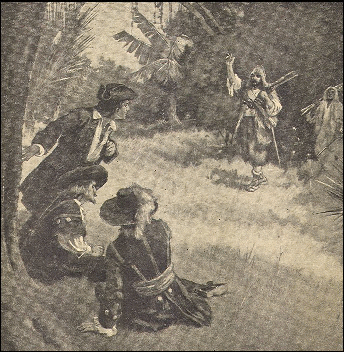
We went quietly down the hill (мы тихонько спустились по холму), keeping ourselves hidden among the trees (скрываясь: «держа нас скрытыми» за деревьями). At last, when we were quite near the three men (наконец, когда мы были довольно близко от трех моряков), I jumped suddenly out before them and cried (я выпрыгнул вдруг перед ними и выкрикнул), "What are you, gentlemen (кто вы, господа)?"
Never were men more surprised (никогда люди не бывали удивлены больше).
They sprang to their feet (они вскочили на ноги; to spring — прыгать, скакать), but they could not speak a word (но не могли выговорить ни слова). In fact, they were on the point of running away from me when I cried (на самом деле, они были готовы убежать от меня, когда я крикнул): "Hold, gentlemen (стойте, господа)! Do not be afraid (не бойтесь). I am a friend (я друг). I bring help (я несу помощь)."
"Then, indeed (тогда, в самом деле)," said one of them (сказал один из них), "you must have been sent from heaven (вы, должно быть, посланы с небес; to send — посылать); for our case is hopeless (ибо наша участь безнадежна)."
"All help is from heaven, sir (любая помощь — с небес, сэр)," I said; and then I briefly told them (а затем кратко рассказал им) how I had seen them brought to the shore (как я видел, как их привезли на берег).
"I am an Englishman (я англичанин)," I said, "and I stand ready to help you (и готов помочь вам: «стою готовым…»). I have one servant (у меня есть слуга), and we are well armed (и мы хорошо вооружены). Tell us what is your case (расскажите нам, в чем ваше дело = что случилось; case — случай, обстоятельство, дело, положение), and how we may serve you (и чем: «как» мы можем служить вам)."
"Our case (наш случай)," said the foremost of the three men (сказал передний/главный из трех человек), "is too long to tell you now (слишком долог, чтобы рассказывать вам сейчас); for our enemies are very near (ибо наши враги очень близко). I was the captain of the ship that lies at anchor offshore (я был капитаном корабля, который стоит: «лежит» на якоре в море). Three days ago the sailors all rose against me (три дня назад моряки все восстали против меня; to rise — подниматься; поднимать восстание, восставать). They made me their prisoner (они сделали меня их пленником). They seized upon the ship (они захватили корабль; to seize — хватать; завладевать, захватывать), for they wanted to become pirates (ибо они хотели стать пиратами).
"They were about to kill me (они собирались убить меня); but this morning they decided to leave me on this island to die (но этим утром они решили оставить меня погибать на острове). The men who are with me, they are doomed to the same fate (люди, которые со мной, приговорены к той же участи). One is my mate (один из них мой помощник), the other a passenger (другой — пассажир).
"Being brought ashore here (поскольку нас высадили на берег здесь: «будучи высаженными на берег здесь»; to bring ashore — высаживать на берег), we had no hope but to perish (у нас не было надежды кроме как погибнуть = и оставалось только погибнуть). For it did not seem to us (потому что нам не казалось = не представлялось возможным) that any one could live in such a desolate place (чтобы кто-то мог жить в таком пустынном месте)."
"But where are those cruel enemies of yours (но где те жестокие ваши враги)?" I asked. "Do you know where they are gone (вы знаете, куда они ушли)?"
"They are there, sir (они там, сэр)," he said, pointing to a grove not far away (указывая на лесок, что был неподалеку). "They are sleeping in the shade (они спят в тени). If they should wake and see you with us (если они проснутся и увидят вас с нами), they would kill us all (они убьют нас всех)."
"Have they any firearms (у них есть огнестрельное оружие)?" I asked.
"Only two muskets (только два мушкета)," he answered, "and one of these they have left in the boat (и один из них они оставили в лодке)."
"Then trust everything to me (тогда доверьте все мне)," I said. "If they are asleep it will be easy to kill them all (если они спят, будет легко убить их всех). But I think it will be better to make them our prisoners (но подумайте, не будет ли лучше сделать их нашими пленниками)."
The captain then told me that there were two very wicked fellows among them (капитан затем сказал мне, что среди них были два больших злодея: «очень злых парня»; wicked — злой, безнравственный) who were the ringleaders (которые были зачинщиками; ring — клика; банда, шайка; leader — ведущий, главарь; to lead — вести).
"It is they who have made all this trouble (это именно они устроили весь этот беспорядок; trouble — беспокойство, волнение, тревога; /общественные/ беспорядки, волнения)," he said. "If they and two others could be overcome the rest would come back and do their duty (если их и двоих других можно будет одолеть, другие вернутся и будут исполнять свой долг). Indeed (в самом деле), I am sure that many of them have gone into this business against their will (я уверен, что многие из них пошли в дело против своей воли)."
rescue ['reskju:], enemy ['enImI], captain ['kxptIn], seize [si:z], decide [dI'saId], die ['daI], passenger ['pxsInGq], business ['bIznqs]
I MAKE A BOLD RESCUE
I KNEW that the tide would not be at its highest again before night. So I thought that I would arm myself, and, as soon as it was dark, would venture out and learn more about my strange visitors if I could. I looked at my guns and got everything ready, and then sat down to wait.
The day, as I have said, was very hot. The three men who had been prisoners still sat under a tree by the shore. But all the rest were in the woods. No doubt they would rest in some shady place until the sun went down.
At about two o'clock I became so uneasy that I could wait no longer.
"Friday," I said, "let us go out and see what we can do."
You should have seen us as we marched out of the castle.
I had two guns on my shoulders and Friday had three. I had on my goatskin coat and my great hat that I have told you about. At my side was a naked sword, and in my belt were two huge pistols.
I must have looked very fierce.
We went quietly down the hill, keeping ourselves hidden among the trees. At last, when we were quite near the three men, I jumped suddenly out before them and cried, "What are you, gentlemen?"
Never were men more surprised.
They sprang to their feet, but they could not speak a word. In fact, they were on the point of running away from me when I cried: "Hold, gentlemen! Do not be afraid. I am a friend. I bring help."
"Then, indeed," said one of them, "you must have been sent from heaven; for our case is hopeless."
"All help is from heaven, sir," I said; and then I briefly told them how I had seen them brought to the shore.
"I am an Englishman," I said, "and I stand ready to help you. I have one servant, and we are well armed. Tell us what is your case, and how we may serve you."
"Our case," said the foremost of the three men, "is too long to tell you now; for our enemies are very near. I was the captain of the ship that lies at anchor offshore. Three days ago the sailors all rose against me. They made me their prisoner. They seized upon the ship, for they wanted to become pirates.
"They were about to kill me; but this morning they decided to leave me on this island to die. The men who are with me, they are doomed to the same fate. One is my mate, the other a passenger.
"Being brought ashore here, we had no hope but to perish. For it did not seem to us that any one could live in such a desolate place."
"But where are those cruel enemies of yours?" I asked. "Do you know where they are gone?"
"They are there, sir," he said, pointing to a grove not far away. "They are sleeping in the shade. If they should wake and see you with us, they would kill us all."
"Have they any firearms?" I asked.
"Only two muskets," he answered, "and one of these they have left in the boat."
"Then trust everything to me," I said. "If they are asleep it will be easy to kill them all. But I think it will be better to make them our prisoners."
The captain then told me that there were two very wicked fellows among them who were the ringleaders.
"It is they who have made all this trouble," he said. "If they and two others could be overcome the rest would come back and do their duty. Indeed, I am sure that many of them have gone into this business against their will."