



I HAVE A QUEER DREAM (я вижу странный сон)
TWO years passed without any alarms (два года прошли без каких-либо тревог; alarm — /боевая/ тревога), and I was beginning to think that nothing would ever again happen to disturb the quiet of my life (и я начинал думать, что ничто никогда не случится опять, что могло бы нарушить спокойствие моей жизни).
One night in the rainy season of March I could not sleep (одной ночью в дождливый мартовский сезон мне не спалось: «я не мог спать»). I lay for hours in my hammock and was not able to close my eyes (я лежал часами в гамаке и не мог: «не был способен» сомкнуть глаз).
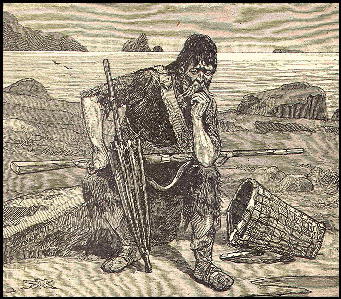
I was thinking, thinking, thinking (я думал, думал, думал).
I thought of all that had ever happened to me both before and after my shipwreck (я думал обо всем, что случилось со мной до и после кораблекрушения; both — оба; both… and… — как … так и …; и … и …).
I thought of my first happy years on the island (я думал о первых счастливых годах на острове).
I thought of the fear and care that I had lived in ever since I saw the first footprint in the sand (я думал о страхе и заботах, в которых я жил постоянно с того времени, как я увидел первый отпечаток ноги в песке).
Then I thought of my great desire to see my native land once more (затем я подумал о моем большом желании увидеть мою родную землю еще раз), and to have friends and companions (и чтобы у меня были друзья и товарищи) with whom I could talk (с которыми я мог бы поговорить).
These thoughts brought to mind the savages of whom I had so great a dread (эти мысли вызвали в уме: «привели на ум» дикарей, которых я столь боялся), and I began to ask myself a thousand questions about them (и я начал спрашивать себя = задавать себе тысячу вопросов о них).
How far off was the coast from which they came (как далеко был берег, с которого они приплывали)?
Why did they come to my island from so great a distance (почему они приплывали на мой остров с такого большого расстояния)?
What kind of boats did they have (что за лодки были у них)?
With such thoughts as these I lay awake until far in the night (с такими мыслями я лежал, бодрствуя, допоздна в ночи). My pulse beat fast (мой пульс бил часто), my breath came hard (дыхание было прерывистым: «приходило тяжело»), my nerves were unstrung (нервы были ослабленными/ненатянутыми = расшатанными; unstrung — ослабленный, ненатянутый /о струнах, луке/ расшатанный /о нервах/; string — веревка; to string — натягивать /струну, тетиву/).
At last (наконец), worn out by my very restlessness (измученный самим моим беспокойством; to wear — носить /одежду, обувь/; изнашивать), I fell asleep (я погрузился в сон).
The same thoughts must have followed me into my dreams (те же самые мысли, должно быть, преследовали меня в снах: «последовали за мной в сновидения»), but they took a different form (но они приняли иную форму).
I dreamed (мне снилось) that I was sitting on the seashore (что я сидел на берегу моря) with my gun on my lap (с ружьем на коленях) and my umbrella by my side (и зонтиком возле меня).
I was thinking, thinking, thinking (я думал, думал, думал). I had never been so sad and lonely (я никогда не был столь грустным и одиноким).
I was thinking of the home I was never to see again (я думал о доме, который мне не суждено было больше: «никогда» увидеть), and of the friends who perhaps had forgotten me (и о друзьях, которые, возможно, забыли меня; to forget — забывать).
Suddenly, as I lifted my eyes (вдруг, когда я поднял глаза), I thought I saw two canoes coming toward the island (мне показалось, что я увидел два каноэ, движущиеся к острову). I ran and hid myself in a grove by the shore (я побежал и спрятался в леске у берега; grove — лесок, роща; to run — бежать; to hide — прятать).
There were eleven savages in the canoes (в лодках было одиннадцать дикарей), and they had with them another savage whom they were going to kill and eat (и с ними был другой дикарь, которого они собирались убить и съесть).
But I thought in my sleep that this savage suddenly sprang up and ran for his life (но я подумал во сне = мне приснилось, что этот дикарь вдруг вскочил и побежал /спасая/ свою жизнь; to spring — прыгать, скакать; to spring up — вскакивать).
I thought that he came running to the little grove, to hide himself in it (я подумал, что он прибежал в маленький лесок, чтобы спрятаться в нем).
Seeing him alone (видя его одного), I arose and met him (я встал и встретил его; to arise — подниматься). I smiled kindly (я улыбнулся по-доброму/ласково), and tried to make him know that I was his friend (и попытался дать ему понять, что я был его другом).
He threw himself on the ground at my feet (он бросился на землю у моих ног; to throw — бросать). He seemed to be asking my help (казалось, он просил помощи: «он казался быть просящим моей помощи»).
I showed him my ladder (я показал ему мою лестницу) and made him go up over the wall (и заставил/пригласил его перелезть стену; to make smb. do smth. — побуждать кого-л. сделать что-л.).
Then I led him into my castle (затем я провел его в замок; to lead — вести), and he became my servant (и он стал моим слугой; to become — становиться).
I thought in my sleep, that I cried aloud for joy (мне показалось в моем сне, что воскликнул громко от радости) and said: "Now I shall escape from this place (теперь я убегу из этого места). For this savage will be my pilot (потому что этот дикарь будет моим лоцманом). He will guide me to the mainland (он укажет мне путь к материку; to guide — вести, быть чьим-л. проводником). He will tell where to go and what to do (он будет говорить мне, куда идти и что делать). He will help me find my own people (он поможет мне найти соотечественников: «моих собственных людей»)."
This thought filled my mind with great joy (эта мысль наполнила мою душу большой радостью) and while I was still rejoicing I awoke (и когда я еще радовался, я проснулся; to awake — просыпаться).
What a disappointment it was to find that it was only a dream (каким разочарованием было обнаружить, что это был только сон)!
For several days I felt very sad (несколько дней подряд мне было очень грустно; to feel — чувствовать). I was almost ready to give up hope (я был почти готов отказаться от надежды).
Then I remembered my dream (затем я вспомнил мой сон); and I said to myself (и сказал самому себе = подумал): "If I could only get hold of a savage (если бы я только смог захватить дикаря) and teach him to love me (и приучить его любить меня), things might turn out just that way (все могло бы обернуться именно так). He must be one of their prisoners (он должен быть одним из пленников) and I must save him from being eaten (и я должен уберечь его от того, чтобы его съели: «от того, чтобы быть съеденным»); for then it will be easy to win his friendship (потому что тогда будет легко добиться его дружбы; to win — выигрывать; добираться, достигать; добиться, получить)."
This thought so fixed itself in my mind (эта мысль так засела у меня в голове) that I could not get rid of it (что я не мог избавиться от нее). Waking or sleeping (бодрствуя или во сне), I seemed to be always planning to get hold of a savage (казалось, я все время обдумывал, как захватить дикаря).
At last I set myself about it in earnest (наконец я настроился на это всерьез; in earnest — всерьез). Almost every day (почти каждый день) I went out with my gun to see (я выходил с ружьем посмотреть) if some of these wild men had not again landed on my island (не высадились ли некоторые из этих диких людей вновь на мой остров).
queer ['kwIq], disturb [dIs'tq:b], both ['bquT], different ['dIf(q)r(q)nt], joy ['GOI], pilot ['paIlqt], people [pi:pl], earnest ['q:nIst]
I HAVE A QUEER DREAM
TWO years passed without any alarms, and I was beginning to think that nothing would ever again happen to disturb the quiet of my life.
One night in the rainy season of March I could not sleep. I lay for hours in my hammock and was not able to close my eyes. I was thinking, thinking, thinking.
I thought of all that had ever happened to me both before and after my shipwreck.
I thought of my first happy years on the island.
I thought of the fear and care that I had lived in ever since I saw the first footprint in the sand.
Then I thought of my great desire to see my native land once more, and to have friends and companions with whom I could talk.
These thoughts brought to mind the savages of whom I had so great a dread, and I began to ask myself a thousand questions about them.
How far off was the coast from which they came?
Why did they come to my island from so great a distance?
What kind of boats did they have?
With such thoughts as these I lay awake until far in the night. My pulse beat fast, my breath came hard, my nerves were unstrung.
At last, worn out by my very restlessness, I fell asleep.
The same thoughts must have followed me into my dreams, but they took a different form.
I dreamed that I was sitting on the seashore with my gun on my lap and my umbrella by my side.
I was thinking, thinking, thinking. I had never been so sad and lonely.
I was thinking of the home I was never to see again, and of the friends who perhaps had forgotten me.
Suddenly, as I lifted my eyes, I thought I saw two canoes coming toward the island. I ran and hid myself in a grove by the shore.
There were eleven savages in the canoes, and they had with them another savage whom they were going to kill and eat.
But I thought in my sleep that this savage suddenly sprang up and ran for his life.
I thought that he came running to the little grove, to hide himself in it.
Seeing him alone, I arose and met him. I smiled kindly, and tried to make him know that I was his friend.
He threw himself on the ground at my feet. He seemed to be asking my help.
I showed him my ladder and made him go up over the wall.
Then I led him into my castle, and he became my servant.
I thought in my sleep, that I cried aloud for joy and said: "Now I shall escape from this place. For this savage will be my pilot. He will guide me to the mainland. He will tell where to go and what to do. He will help me find my own people."
This thought filled my mind with great joy and while I was still rejoicing I awoke.
What a disappointment it was to find that it was only a dream!
For several days I felt very sad. I was almost ready to give up hope.
Then I remembered my dream; and I said to myself: "If I could only get hold of a savage and teach him to love me, things might turn out just that way. He must be one of their prisoners and I must save him from being eaten; for then it will be easy to win his friendship."
This thought so fixed itself in my mind that I could not get rid of it. Waking or sleeping, I seemed to be always planning to get hold of a savage.
At last I set myself about it in earnest. Almost every day I went out with my gun to see if some of these wild men had not again landed on my island.
I GET HOLD OF A SAVAGE (я захватываю дикаря)
FOR a year and a half I kept close watch upon the farther shore of the island as well as upon that nearest to my castle (в течение полутора лет я держал постоянное наблюдение за дальним берегом острова, равно как и за тем /берегом, который был/ ближайшим к замку). But not a single savage came near (но ни один дикарь не приблизился = не появился; single — один; единственный; одиночный).
One morning in June, however (однако одним июньским утром), I had a great surprise (я получил большое удивление = случилось неожиданное для меня).
I was just starting out from my castle (я как раз выходил из моего замка) when I saw five canoes lying high and dry on the beach not a mile away (когда увидел пять каноэ, лежащих вытащенными на берег: «высоко и сухими» на берегу не более мили вдалеке = на расстоянии не более мили; high and dry — выброшенный, вытащенный на берег /о судне/). There was not a man near them (не было ни одного человека рядом с ними). The people who had come in them were perhaps asleep among the trees (люди, которые прибыли на них, возможно, спали между деревьями).
The number of canoes was greater (число каноэ было больше) than I had ever counted upon seeing (чем я когда-либо рассчитывал увидеть). For there were always four or six savages in each canoe (потому что в каждом каноэ всегда было четыре или шесть дикарей; always — всегда, неизменно), and there must now be between twenty and thirty men somewhere on the shore (и /значит/ должно быть между двадцатью и тридцатью мужчин где-то на берегу).
I did not know what to think of it (я не знал, что думать об этом). I did not feel brave enough to attack so many (я не чувствовал себя достаточно смелым, чтобы напасть на столь многих).
So I stayed in my castle (поэтому я остался в замке) and made ready to defend myself (и приготовился защищаться: «защищать себя»).
"There is little hope of getting a savage this time (мало надежды заполучить дикаря в этот раз)," I thought to myself (подумал я про себя).
I waited a long while (я ждал долго), but heard no unusual sound (но не услышал никаких необычных звуков). I grew tired of waiting (я устал: «стал уставшим» от ожидания = мне надоело ждать; to grow — становиться; tired — усталый, уставший; потерявший интерес, пресытившийся), and made up my mind to see what was going on (и решил посмотреть, что происходило).
So, with the help of my ladder (итак, с помощью лестницы), I climbed up to my lookout on the top of the rock (я взобрался на мою смотровую площадку на вершине скалы). I put my spyglass to my eyes (я приставил подзорную трубу к глазам) and looked down upon the beach (и посмотрел вниз на берег).
Surely enough (и действительно: «достаточно несомненно»; surely — конечно, непременно; несомненно)! there they were (они там были). I saw no fewer than thirty naked savages dancing around a fire (я увидел не менее тридцати обнаженных дикарей, танцующих вокруг огня; to dance — танцевать). I saw that they were broiling meat upon the coals (я видел, что они варили мясо на углях), but I could not tell what kind of meat it was (но я не мог различить, что это было за мясо).
As I watched I saw some of the dancers run to a boat and drag two miserable prisoners from it (когда я /так/ наблюдал, я увидел, как несколько танцоров побежали к лодке и притащили с нее двух несчастных пленников). They must have been in the boat all the time (должно быть, они были в лодке все это время), but as they were lying down I did not see them (но так как они лежали, я не видел их).
All the dancers now crowded around the poor prisoners (все танцоры столпились теперь вокруг несчастных пленников). They knocked one of them down with a club (они сбили одного с ног дубинкой), and then fell upon him with their knives (и затем набросились на него с ножами). I supposed they were going to cut him up for their horrid feast (я предположил, что они собирались разрезать его для своего страшного пира; to cut up — разрубать, разрезать на куски).
For a few moments they seemed to forget the other prisoner (на несколько мгновений они, казалось, забыли о другом пленнике), for they left him standing alone at one side (так как оставили его одного, стоящим в стороне).
All at once he made a break for liberty (неожиданно он сделал попытку убежать: «сделал рывок к свободе»). You never saw a hound run so fast (вы никогда не видели, чтобы гончая бежала так быстро). He ran along the sandy beach (он бежал вдоль песчаного берега), right toward my castle (прямо к моему замку). I was dreadfully frightened (я был ужасно напуган). I thought that now my dream was coming true (я подумал, что мой сон сбывался: «становился правдивым»; true — правдивый, достоверный), and that he would surely hide in my grove (и что он непременно спрячется в моей роще).
But would the other part of the dream come true (но сбудется ли другая часть сна)? Would the other savages lose sight of him (потеряют ли другие = остальные дикари его из виду), and running another way, not come near the castle (и, убегая по другому пути, не придут близко к моему замку) ? I feared not (я опасался, что нет = что этого не произойдет).
However, I stayed in my lookout and watched to see what would happen (тем не менее, я оставался на смотровой площадке и наблюдал, чтобы увидеть, что произойдет).
I saw, to my joy (я увидел, к моей радости), that only three of the savage followed him (что только трое из дикарей последовали за ним). He ran so fast that he gained ground on them (он бежал так быстро, что оторвался от них: «выиграл землю»). If he could hold out for ten or fifteen minutes (если он продержится десять-пятнадцать минут), he would get away from them all (он сможет убежать от них всех; to get away — уходить; отправляться; удирать; выбираться).
Between the savages and my castle there was the little river (между дикарями и моим замком была маленькая река) where I had first landed with my raft (в которой я в самом начале пристал со своим плотом). If the poor fellow could not swim across this stream, he would surely be taken (если бы бедняга не сможет переплыть этот поток, он точно будет схвачен). I watched to see what he would do (я наблюдал, что же он будет делать).
To my surprise the river did not hinder him at all (к моему удивлению, река не остановила его вовсе; to hinder — задерживать, затруднять, мешать, препятствовать). The tide was up (был прилив: «поток был вверх»), but he plunged in (но он нырнул) and with twenty or thirty strokes was across (и двадцатью-тридцатью гребками переплыл; across — поперек, на ту сторону). I had never seen a finer swimmer (я никогда не видел лучшего пловца).
When his pursuers reached the stream (когда его преследователи достигли потока; to pursue — преследовать), he was already far away (он был уже далеко). Two of them jumped in and swam across (двое из них прыгнули в /воду/ и переплыли /речку/). The other one stood still a minute (другой = третий постоял с минуту на месте; to stand still — стоять на месте) and then turned softly back (а затем повернул тихонько назад). It was lucky for him that he could not swim (для него было удачей: «удачно» то, что он не мог плавать).
"Now," thought I to myself, "now is the time to get me a savage (теперь время добыть себе дикаря)!"
In another moment I was down in my castle (через мгновение я был /уже/ внизу, в замке). I picked up my two guns (я подхватил два ружья). I was over the wall in less time than it takes me to tell about it (я был на стене за меньше время, чем мне требуется, чтобы об этом сказать). Never once did I think of fear (ни разу я не подумал о страхе).
I ran swiftly down the hill toward the sea (я быстро сбежал вниз по холму к морю). In another minute I was between the poor captive and his pursuers (в следующую минуту я был между бедным пленником и его преследователями).
"Hello, there (эй, ты: «эй, там»)! Come back (вернись: «приди назад»)! I will help you (я помогу тебе)," I cried (крикнул я).
Of course he did not understand a word (конечно же, он не понял ни слова). But he heard me and looked back (но он услышал меня и оглянулся: «посмотрел назад»). I beckoned to him with my hand (я махнул ему рукой; to beckon — манить, кивать; делать знак /рукой, пальцем/), and this he understood better (и это он понял лучше).
There was no time for waiting (не было времени ждать), however (однако). The two savages that followed were close upon me (двое дикарей, которые последовали /за ним/, были близко ко мне).
I rushed upon the foremost one (я бросился на переднего; to rush — бросаться, мчаться, устремляться; foremost — передний, передовой, находящийся впереди других) and knocked him down with my gun (и сбил его с ног ружьем). I did not want to shoot (я не хотел стрелять), lest the other savages would hear the noise and come to his rescue (чтобы другие дикари не услышали шум и не пришли ему на помощь).
The second pursuer came (второй преследователь приблизился), running and panting (бегом и задыхаясь), only a little way behind (лишь немного отстав; behind — сзади, позади). When he saw me (когда он увидел меня), he stopped as if he were frightened (он остановился, как будто был напуган). I ran toward him (я побежал к нему), with my gun to my shoulder (с ружьем на плече).
As I came nearer (когда я приблизился: «подошел ближе»), I saw that he had a bow and arrow (я увидел, что у него были лук и стрела) and was taking aim at me (и что он целился в меня: «брал цель»). What could I do but shoot (что я мог сделать, кроме как выстрелить)? He fell to the ground and never moved again (он упал на землю и никогда не пошевелился опять = и больше не шевелился).
I now looked around to see what had become of the poor captive (я осмотрелся, чтобы увидеть, что стало с бедным пленником). I saw him standing still and gazing at me (я увидел егостоящим неподвижно и глазеющим/уставившимся на меня; to gaze — пристально глядеть; вглядываться; уставиться). The noise of my gun had frightened him so (шум моего ружья так испугал его) that he did not know what to do (что он не знал, что делать).
I called to him (я окликнул его): "Come here (иди сюда), my good fellow (приятель: «мой добрый товарищ»), I will not hurt you (я не обижу тебя; to hurt — причинить боль, ранить; обидеть)."
But of course he did not understand (конечно, он не понял). Then I motioned to him with signs (тогда я показал ему знаками; to motion — приглашать жестом, показывать жестом /что нужно или можно сделать/). He came a little way and then stopped (он подошел немного и затем остановился). He came a little farther (он подошел немного дальше) and stopped again (и вновь остановился). He was trembling like a leaf (он дрожал как лист).
No doubt (без сомнения) he was afraid that he would be killed as his two pursuers had been (он боялся, что будет убит, как были убиты два его преследователя).
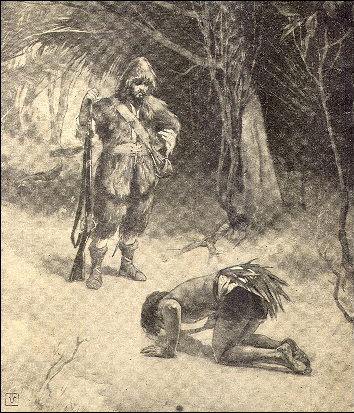
I spoke kindly to him (я заговорил с ним доброжелательно) and made signs that I would not hurt him (и сделал знаки = знаками показал, что не причиню ему вреда). He came nearer and nearer (он подходил все ближе), trembling (дрожа), and kneeling down at almost every step (и чуть не вставая на колени почти при каждом шаге; to kneel down — преклонять колени, вставать на колени).
I smiled (я улыбнулся); I looked as pleasant as I could (я смотрел так мягко/любезно, как мог); I made still other signs (я еще делал другие знаки = продолжал делать знаки; still — до сих пор, /все/ еще, по-прежнему).
He came quite close to me (он подошел довольно близко ко мне). He laid his head upon the ground (он положил голову на землю; to lay — класть). He took hold of my foot and set it on his neck (он схватил мою ногу и поставил себе на шею). This was his way of saying that he would be my slave forever (это был способ сказать, что он будет моим рабом навсегда).
I took hold of his hand and lifted him up (я взял его руку и поднял его). I spoke kindly to him (я говорил с ним мягко).
Thus I at last got hold of a savage, as I had so long desired (таким образом я захватил дикаря, как я так долго хотел).
attack [q'txk], unusual ['An'ju:Zuql], dance [dQ:ns], miserable ['mIz(q)r(q)bl], prisoner ['prIznq], horrid ['hOrId], once [wAns], break ['breIk], liberty ['lIbqtI], fellow ['felqu], plunge [plAnG], pursuer [pq'sju:q], understood ["Andq'stu:d], foremost ['fO:mqust], pant [pQ:nt], poor ['puq], captive ['kxptIv], forever [fq'revq], desire [dI'zaIq]
I GET HOLD OF A SAVAGE
FOR a year and a half I kept close watch upon the farther shore of the island as well as upon that nearest to my castle. But not a single savage came near. One morning in June, however, I had a great surprise.
I was just starting out from my castle when I saw five canoes lying high and dry on the beach not a mile away. There was not a man near them. The people who had come in them were perhaps asleep among the trees.
The number of canoes was greater than I had ever counted upon seeing. For there were always four or six savages in each canoe, and there must now be between twenty and thirty men somewhere on the shore.
I did not know what to think of it. I did not feel brave enough to attack so many.
So I stayed in my castle and made ready to defend myself.
"There is little hope of getting a savage this time," I thought to myself.
I waited a long while, but heard no unusual sound. I grew tired of waiting, and made up my mind to see what was going on.
So, with the help of my ladder, I climbed up to my lookout on the top of the rock. I put my spyglass to my eyes and looked down upon the beach.
Surely enough! there they were. I saw no fewer than thirty naked savages dancing around a fire. I saw that they were broiling meat upon the coals, but I could not tell what kind of meat it was.
As I watched I saw some of the dancers run to a boat and drag two miserable prisoners from it. They must have been in the boat all the time, but as they were lying down I did not see them.
All the dancers now crowded around the poor prisoners. They knocked one of them down with a club, and then fell upon him with their knives. I supposed they were going to cut him up for their horrid feast.
For a few moments they seemed to forget the other prisoner, for they left him standing alone at one side.
All at once he made a break for liberty. You never saw a hound run so fast. He ran along the sandy beach, right toward my castle. I was dreadfully frightened. I thought that now my dream was coming true, and that he would surely hide in my grove.
But would the other part of the dream come true? Would the other savages lose sight of him, and running another way, not come near the castle? I feared not.
However, I stayed in my lookout and watched to see what would happen.
I saw, to my joy, that only three of the savage followed him. He ran so fast that he gained ground on them. If he could hold out for ten or fifteen minutes, he would get away from them all.
Between the savages and my castle there was the little river where I had first landed with my raft. If the poor fellow could not swim across this stream, he would surely be taken. I watched to see what he would do.
To my surprise the river did not hinder him at all. The tide was up, but he plunged in and with twenty or thirty strokes was across. I had never seen a finer swimmer.
When his pursuers reached the stream, he was already far away. Two of them jumped in and swam across. The other one stood still a minute and then turned softly back. It was lucky for him that he could not swim.
"Now," thought I to myself, "now is the time to get me a savage!"
In another moment I was down in my castle. I picked up my two guns. I was over the wall in less time than it takes me to tell about it. Never once did I think of fear.
I ran swiftly down the hill toward the sea. In another minute I was between the poor captive and his pursuers.
"Hello, there! Come back! I will help you," I cried.
Of course he did not understand a word. But he heard me and looked back. I beckoned to him with my hand, and this he understood better.
There was no time for waiting, however. The two savages that followed were close upon me.
I rushed upon the foremost one and knocked him down with my gun. I did not want to shoot, lest the other savages would hear the noise and come to his rescue.
The second pursuer came, running and panting, only a little way behind. When he saw me, he stopped as if he were frightened. I ran toward him, with my gun to my shoulder.
As I came nearer, I saw that he had a bow and arrow and was taking aim at me. What could I do but shoot? He fell to the ground and never moved again.
I now looked around to see what had become of the poor captive. I saw him standing still and gazing at me. The noise of my gun had frightened him so that he did not know what to do.
I called to him: "Come here, my good fellow I will not hurt you."
But of course he did not understand. Then I motioned to him with signs. He came a little way and then stopped. He came a little farther and stopped again. He was trembling like a leaf.
No doubt he was afraid that he would be killed as his two pursuers had been.
I spoke kindly to him and made signs that I would not hurt him. He came nearer and nearer, trembling, and kneeling down at almost every step.
I smiled; I looked as pleasant as I could; I made still other signs.
He came quite close to me. He laid his head upon the ground. He took hold of my foot and set it on his neck. This was his way of saying that he would be my slave forever.
I took hold of his hand and lifted him up. I spoke kindly to him.
Thus I at last got hold of a savage, as I had so long desired.
I AM PLEASED WITH MY MAN FRIDAY (я доволен моим слугой Пятницей; man — человек; слуга)
THE savage spoke to me (дикарь заговорилсо мной; to speak — говорить). I could not understand his words (я не мог понять его слов), but they were very pleasant to hear (но они были приятными на слух/было приятно их слышать). For it had now been more than twenty-five years since I had heard the sound of a man's voice (так как было = прошло уже более двадцати пяти лет с того времени, когда я слышал звук человеческого голоса).
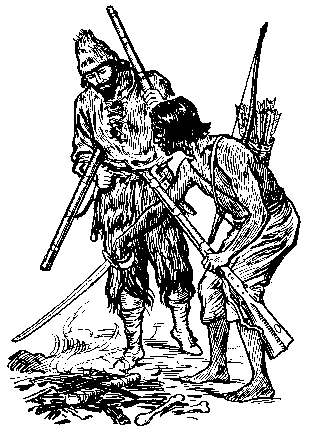
He pointed to the two savages (он указал на двух дикарей) who had been pursuing him (которые /ранее/ преследовали его). They were lying on the ground where they had fallen (они лежали на земле, там, где они упали). Both were quite dead (оба были совершенно мертвы).
He could not understand how I had killed the second savage (он не мог понять, как я убил второго дикаря) when he was so far away from me (когда он был так далеко от меня). He made signs that I should let him see whether his enemy was really dead or only pretending to be so (он делал знаки, что я должен дать ему посмотреть, действительно ли его враг был мертв или только притворялся быть таковым).
I told him, as well as I could (я сказал ему, насколько смог: «так хорошо, как я мог»), that he might go to him (что он может пойти к нему). He ran to the fallen savage and looked at him (он подбежал к упавшему дикарю и посмотрел на него). He turned him first on one side and then on the other (он перевернул его сначала на одну сторону, а затем на другую). He seemed very much puzzled (он казался очень озадаченным; puzzle — вопрос, ставящий в тупик; головоломка, загадка; to puzzle — приводить в затруднение, ставить в тупик; озадачивать).
Then he picked up the savage's bow and arrows (затем он подобрал лук и стрелы дикаря) and brought them to me (и принес их мне; to bring — приносить).
I turned to go back to my castle (я повернулся, чтобы идти обратно в замок) and beckoned him to follow me (и поманил его последовать за мной).
He stood quite still for a moment (он стоял совершенно неподвижно какое-то мгновение) and then pointed again to the bodies on the ground (а затем указал опять на тела на земле). By signs he asked me if he might bury them (знаками он спросил меня, мог ли похоронить их), lest the other savages should come up and find them there (чтобы другие дикари не смогли прийти и найти их там). I answered by signs (я ответил знаками) and gave him leave (и дал ему разрешение).
The work was quickly done (работа была быстро сделана). With a sharp stick (острой палкой) and his big hands (и своими большими руками; hand — кисть руки; ладонь) he soon dug two big holes in the sand (он вскоре вырыл две большие ямы в песке). He laid the bodies in them and covered them up (он положил в них тела и покрыл = засыпал их; to lay — класть). Then he smoothed the sand (затем он разровнял песок) and patted it down so (и прибил/утрамбовал его так; to pat — похлопывать; поглаживать; шлепать; бить, ударять /плоским или тупым предметом/) that no one could see that it had been touched (что никто не смог бы увидеть, что он был тронут = что здесь рыли).
Having thus put the two savages out of sight he turned to me again (убрав таким образом двоих дикарей из виду, он снова повернулся ко мне). I motioned him to follow me (я показал ему знаком следовать за мной). But on second thought (но, поразмыслив: «на второй мысли») I did not go back to the castle (я не пошел обратно в замок). I led him far into the woods (я отвел его далеко в лес; to lead — вести), to my new cave of which I have told you (к моей новой пещере, о которой я рассказывал вам).
Once inside of that cave (зайдя внутрь пещеры/оказавшись внутри пещеры; once — один раз; раз, разок; единожды, однажды), I felt safe (я почувствовал себя в безопасности).
I gave the poor fellow some bread and a bunch of raisins to eat (я дал бедняге поесть хлеб и горсть изюма). I gave him also a drink of water from a jug (я дал ему также глоток воды = попить воды из кувшина), and he was so thirsty (и он так хотел пить; to be thirsty — испытывать жажду: «быть жаждущим»; thirst — жажда) from running (от бега = оттого, что бежал) that he came near drinking it all (что он чуть не выпил его /кувшин/ весь).
Then I showed him a place where I had put some rice straw (затем я показал ему место, где я положил рисовую солому) with a blanket over it (с одеялом на ней). It was quite a good bed (это была довольно хорошая постель), and I myself had sometimes slept upon it (и я сам иногда спал на ней).
He seemed to know (казалось, он понял) that I meant for him to lie down there and rest (что я указывал ему лечь здесь и отдохнуть; to mean — иметь в виду; думать, подразумевать). Soon he was fast asleep (вскоре он крепко спал: «был крепко спящим»).
He was a handsome fellow (он был красивый/стройный парень). He was tall but not too large (он был высоким, но не слишком большим).
His hair was long and black (его волосы были длинными и черными). His forehead was high and broad (его лоб был высоким и широким). His eyes were very bright (его глаза были яркими = ясными).
His face was round and plump (его лицо было круглым и полным; plump — полный; округлый, пухлый). His nose was well shaped (егонос был хорошей формы: «хорошо сформирован»). His lips were thin (его губы были тонкими). His teeth were white as ivory (его зубы были белыми как слоновая кость).
His skin was not black like that of an African (его кожа не была черной). It was not yellow like that of some Indians (она не была желтой, как кожа некоторых индейцев). But it was a kind of olive color (но она была оттенком оливкового цвета), very pleasant to look at (очень приятной на вид: «приятной, чтобы смотреть на нее»).
After he had been asleep about an hour he awoke (после того, как он проспал около часа, он проснулся; to awake — просыпаться) and came out of the cave where I was milking my goats (и вышел из пещеры туда, где я доил моих коз). He made signs to show that he was glad to see me (он сделал знаки, чтобы показать, что он рад видеть меня).
Then he laid his head flat down on the ground (затем он положил голову плоско вниз на землю = прижал к земле) and set my foot upon it (и поставил на нее мою ногу), as he had done before (как он сделал это прежде). This was his way of saying that he would do anything I wished (это был его способ сказать, что сделает все, что я пожелаю).
I understood him and told him by signs that I was well pleased with him (я понял его и сказал ему знаками, что я доволен им).
I spoke some simple words to him (я сказал ему несколько простых слов) and tried to teach him what they meant (и попробовал научить его = объяснить ему, что они обозначали; to mean — значить). He was quick to learn and soon began to try to talk to me (он быстро учился: «был быстр учиться» и скоро начал пытаться говорить со мной).
I named him FRIDAY (я назвал его Пятница), because it was on that day of the week that I had saved his life (потому что именно в этот день недели я спас его жизнь).
He soon learned to call me "Master" (он вскоре научился называть меня «хозяин»), and to say "yes" and "no" in the right way (и говорить «да» и «нет» правильно = и различать «да» и «нет»).
In the evening I gave him an earthen pot with some milk in it (вечером я дал ему глиняный горшок с молоком), and showed him how to sop his bread in the milk (и показал, как мочить хлеб в молоке). I also gave him a barley cake (я также дал ему ячменную лепешку), which he ate as though it was very good (которую он съел, как будто она была очень хороша).
All that night we stayed in the cave (всю эту ночь мы оставались в пещере). But early the next morning I led him back to my castle (но рано следующим утром я повел его назад в замок).
My first care was to learn whether the savages had left the island (первой моей заботой было выяснить, покинули ли дикари остров). I climbed to the top of the rock and looked around with my spyglass (я забрался на вершину скалы и осмотрелся при помощи подзорной трубы).
I saw the place where the savages had been (я увидел место, где побывали дикари). I saw where they had built their fire (я увидел, где они разводили костер). But they were not there (но их там не было). I could see no sign of them or of their canoes (я не смог разглядеть никаких признаков их или их каноэ). It was plain that they had left the place (было ясно, что они покинули это место; to leave — оставлять, покидать).
I gave my man Friday one of my guns to carry (я дал моему слуге Пятнице нести одно из моих ружей). In his right hand he held my sword (в правой руке он держал мою шпагу), and on his back were his bow and arrows (а на его спине были его лук и стрелы = а на спине он нес лук и стрелы).
I carried two guns myself (я сам нес два ружья). And thus armed (и /будучи/ так вооруженными) we went boldly down to the beach (мы отважно спустились к берегу).
The sand was red with blood (песок был красным от крови), and bones and bits of flesh were scattered all around (а кости и куски мяса были разбросаны везде вокруг). These I caused Friday to gather up and bury (я приказал Пятнице собрать их и похоронить).
We stayed on the beach for some time (мы оставались на берегунекоторое время), but could find nothing more (но ничего больше не могли найти).
Friday gave me to understand (Пятница дал мне понять) that there had been three other prisoners in the boats with him (что в лодках вместе с ним было три других пленника = еще три пленника). I had no doubt (у меня не было никаких сомнений) that the savages had killed and eaten them all (что дикари убили и съели всех их).
The next day I made a tent for Friday to stay in (на следующий день я сделал навес для Пятницы, чтобы /он мог/ оставаться там = жить; to stay — останавливаться, жить; оставаться /где-л./, задержаться /где-л./). It was just inside of my castle wall (он был точно/как раз внутри моей стены замка = сразу за стеной замка) and in front of the door into my own sleeping room (и перед дверью /ведущей/ в мою собственную спальню).
As he had no clothes (поскольку у него не было одежды) I set to work to make him a suit (я принялся за работу, чтобы сделать ему костюм). I gave him some linen trousers (я дал ему льняные штаны) which had belonged to one of our sailors (которые принадлежали одному из наших моряков), and which I had not worn because they were too small (и которые я не носил, потому что они были слишком малы; to wear — носить /одежду, обувь/).
Then I made him a little jacket of goatskin (затем я сделал ему курточку из козьей шкуры), and from the skin of a rabbit (а из кожи кролика) I fashioned a very good cap (я сшил ему очень хорошую шапку; fashion — форма, очертания; покрой /об одежде/; to fashion — придавать форму; создавать) that fitted his head quite well (которая подходила к его голове вполне хорошо).
You should have seen him when he was clothed (вам стоило бы посмотреть на него, когда он был так одет). He was very proud, but oh, so awkward (он был очень горд, но, Боже мой, столь неуклюж)!
He went around with a broad smile on his face (он расхаживал: «ходил вокруг» с широкой улыбкой на лице). He tried to do everything that was pleasing to me (он старался делать все, что было мне приятно).
And indeed I was much delighted with him (и в самом деле, я был очень рад ему/доволен им). For no man ever had a more faithful servant (потому что ни у кого не было более преданного слуги; faith — вера; доверие).
Friday ['fraIdeI, 'fraIdI], pursue [pq'sju:], dead [ded], really ['rI(q)lI], pretend [prI'tend], body ['bOdI], forehead ['fOrId], nose ['nquz], teeth [ti:T], ivory ['aIv(q)rI], olive ['OlIv], color ['kAlq], quick [kwIk], talk [tO:k], blood [blAd], bury ['berI], linen ['lInIn], trousers ['trauzqz], because [bI'kO:z], faithful ['feITf(q)l]
I AM PLEASED WITH MY MAN FRIDAY
THE savage spoke to me. I could not understand his words, but they were very pleasant to hear. For it had now been more than twenty-five years since I had heard the sound of a man's voice. He pointed to the two savages who had been pursuing him. They were lying on the ground where they had fallen. Both were quite dead.
He could not understand how I had killed the second savage when he was so far away from me. He made signs that I should let him see whether his enemy was really dead or only pretending to be so.
I told him, as well as I could, that he might go to him. He ran to the fallen savage and looked at him. He turned him first on one side and then on the other. He seemed very much puzzled.
Then he picked up the savage's bow and arrows and brought them to me.
I turned to go back to my castle and beckoned him to follow me.
He stood quite still for a moment and then pointed again to the bodies on the ground. By signs he asked me if he might bury them, lest the other savages should come up and find them there. I answered by signs and gave him leave.
The work was quickly done. With a sharp stick and his big hands he soon dug two big holes in the sand. He laid the bodies in them and covered them up. Then he smoothed the sand and patted it down so that no one could see that it had been touched.
Having thus put the two savages out of sight he turned to me again. I motioned him to follow me. But on second thought I did not go back to the castle. I led him far into the woods, to my new cave of which I have told you.
Once inside of that cave, I felt safe.
I gave the poor fellow some bread and a bunch of raisins to eat. I gave him also a drink of water from a jug, and he was so thirsty from running that he came near drinking it all.
Then I showed him a place where I had put some rice straw with a blanket over it. It was quite a good bed, and I myself had sometimes slept upon it.
He seemed to know that I meant for him to lie down there and rest. Soon he was fast asleep.
He was a handsome fellow. He was tall but not too large.
His hair was long and black. His forehead was high and broad. His eyes were very bright.
His face was round and plump. His nose was well shaped. His lips were thin. His teeth were white as ivory.
His skin was not black like that of an African. It was not yellow like that of some Indians. But it was a kind of olive color, very pleasant to look at.
After he had been asleep about an hour he awoke and came out of the cave where I was milking my goats. He made signs to show that he was glad to see me.
Then he laid his head flat down on the ground and set my foot upon it, as he had done before. This was his way of saying that he would do anything I wished.
I understood him and told him by signs that I was well pleased with him.
I spoke some simple words to him and tried to teach him what they meant. He was quick to learn and soon began to try to talk to me.
I named him FRIDAY, because it was on that day of the week that I had saved his life.
He soon learned to call me "Master," and to say "yes" and "no" in the right way.
In the evening I gave him an earthen pot with some milk in it, and showed him how to sop his bread in the milk. I also gave him a barley cake, which he ate as though it was very good.
All that night we stayed in the cave. But early the next morning I led him back to my castle.
My first care was to learn whether the savages had left the island. I climbed to the top of the rock and looked around with my spyglass.
I saw the place where the savages had been. I saw where they had built their fire. But they were not there. I could see no sign of them or of their canoes. It was plain that they had left the place.
I gave my man Friday one of my guns to carry. In his right hand he held my sword, and on his back were his bow and arrows.
I carried two guns myself. And thus armed we went boldly down to the beach.
The sand was red with blood, and bones and bits of flesh were scattered all around. These I caused Friday to gather up and bury.
We stayed on the beach for some time, but could find nothing more.
Friday gave me to understand that there had been three other prisoners in the boats with him. I had no doubt that the savages had killed and eaten them all.
The next day I made a tent for Friday to stay in. It was just inside of my castle wall and in front of the door into my own sleeping room.
As he had no clothes I set to work to make him a suit. I gave him some linen trousers which had belonged to one of our sailors, and which I had not worn because they were too small.
Then I made him a little jacket of goatskin, and from the skin of a rabbit I fashioned a very good cap that fitted his head quite well.
You should have seen him when he was clothed. He was very proud, but oh, so awkward!
He went around with a broad smile on his face. He tried to do everything that was pleasing to me.
And indeed I was much delighted with him. For no man ever had a more faithful servant.
I TEACH FRIDAY MANY THINGS (я учу Пятницу многим вещам)
WHEN my man Friday had been with me three days I took him out hunting (когда мой слуга Пятница пробыл со мной три дня, я взял его на охоту).
As we were going through some woods (когда мы шли через лес), I saw a wild goat lying under a tree with two young kids sitting by her (я увидел дикую козу, лежащую под деревом с двумя молодыми козлятами, сидящими рядом с ней). I caught hold of Friday (я схватил Пятницу).
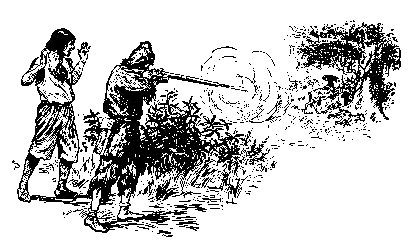
"Stop," I said. "Stand still (стой смирно)."
Then I took aim at one of the kids (затем я прицелился в одного из козлят; to take aim — целиться: «брать цель»), shot and killed it (выстрелил и убил его; to shoot — стрелять).
The noise of the gun so frightened the poor savage (шум ружья так испугал бедного дикаря) that he did not know what to do (что он не знал, что делать). He shook like a leaf (он трясся как лист; to shake — трясти/сь/). He thought that I was going to kill him (он подумал, что я собираюсь убить его).
He did not see the kid I had shot (он не видел козленка, которого я застрелил). He threw himself at my feet (он бросился к моим ногам; to throw — бросать). Although I could not understand a word he said (хотя я не мог понять ни слова из того, что он говорил), yet I knew that he was begging me to have pity on him (все же я знал = понял, что он просил меня иметь жалость к нему = помиловать его).
And indeed I did pity him (и я в самом деле пожалел его) — he was so frightened (он был так напуган).
I took him by the hand and lifted him up (я взял его за руку и поднял). I laughed at him (я рассмеялся) and pointed to the kid that I had killed (и показал на козленка, которого я убил). When he saw it and understood me (когда он увидел его и понял меня), he ran to fetch it (он побежал подобрать его; to fetch — принести, достать; приносить убитую дичь /о собаке/).
Going on through the woods (продолжая идти по лесу: «через лес»), I saw a big bird sitting on a tree (я увидел большую птицу, сидящую на дереве). I thought it was a hawk (я подумал, что это ястреб/сокол).
"See there, Friday (посмотри-ка, Пятница)!" I said, as I pointed to it (указывая на нее: «когда я указывал на нее»).
Bang (бам)! went my gun (выстрелило: «пошло» мое ружье). The bird fell to the ground (птица упала на землю; to fall — падать). It was not a hawk, but a parrot (это был не ястреб, а попугай).
Friday was amazed (Пятница был удивлен; to amaze — изумлять, поражать, удивлять). He looked at the gun and trembled (он смотрел на ружье и дрожал).
For a long time he would not touch a gun (долгое время он не хотел прикасаться к ружью). He would look at it and talk to it (он смотрел на него и заговаривал с ним). He would say, in his own language (он говорил на своем языке): "O wonderful thing (о удивительная вещь)! Do not kill me (не убивай меня)! Do not kill me!"
We found nothing more in the woods that day (в тот день мы больше ничего не нашли в лесу). Friday carried the kid home (Пятница отнес козленка домой), and I took off its skin and dressed it (а я снял с него шкуру и приготовил/приправил его; to dress — готовить /что-л. для использования/; ; готовить, приправлять /еду/). Then I stewed some of the best pieces (затем я потушил несколько лучших кусков) and made some good broth (и приготовил хорошую похлебку).
At dinner I gave some of the broth to my man (во время обеда я дал немного похлебки моему слуге). He liked it very well (она ему очень понравилась), but he could not bear salt in it (но он не мог выносить соль в ней).
I tried to show him that food was best with a little salt (я попытался показать ему, что пища была лучше с небольшим количеством соли = если приправить ее немного солью). But he did not think so (но он так не думал), and he would never eat meat that was salted (и никогда не хотел есть мясо, которое было посолено).
The next day I set Friday to work (на следующий день я дал Пятнице работу; to set — сажать; засаживать /кого-л. за работу/, поручать, заставлять /что-л. делать/). I had him thrash some barley for me (я заставил его молоть ячмень вместо меня) and grind the grains into meal (и молоть зерно в муку) as I had always done (как я всегда делал).
He did his work very well (он очень хорошо справлялся со своей работой).
Then I let him see me make some bread and bake it (затем я дал ему посмотреть, как я делаю хлеб и пеку его). He learned very fast (он учился очень быстро) and soon could cook (и вскоре мог готовить) and keep house as well as any one (и смотреть за домом: «держать дом = вести хозяйство», как любой другой).
Little by little I taught him how to work on my farm (мало-помалу я обучил его, как работать на моей ферме; little by little — мало-помалу, понемногу, постепенно). We fenced another field and sowed more barley (мы огородили другое поле и посеяли больше ячменя). For now there were two mouths to feed instead of one (потому что теперь было два рта, чтобы кормить = которые надо было кормить, вместо одного).
Very soon Friday learned to talk quite well (очень скоро Пятница научился говорить вполне хорошо). He learned the name of everything he saw (он выучил имя/название всего, что он видел). He was very quick (он был очень быстр), and I took pleasure in teaching him (и было приятно учить его; to take pleasure in smth. — получать удовольствие от чего-л.: «брать удовольстве в чем-л.»).
I told him all about gunpowder and guns (я рассказал ему все о порохе и ружьях) and showed him how to shoot (и показал ему, как стрелять). I gave him a knife (я дал ему нож), which pleased him not a little (который ему очень понравился). I made him a belt (я сделал ему пояс) and gave him a hatchet to carry in it (и дал ему топорик, чтобы носить в нем = за поясом).
I told him about the countries on the other side of the great ocean (я рассказал ему о странах на другой стороне большого океана). And I told him something of my own history (и я рассказал ему кое-что из моей собственной истории).
Little by little I explained (постепенно я объяснил) how my people traded in great ships (как мои люди = мои соотечественники торговали на больших судах), and how my own ship had been wrecked on the coast of this island (и как мой собственный корабль потерпел кораблекрушение на побережье этого острова).
Thus, between working and teaching (так, между работой и обучением), I forgot all my fears (я забыл все мои страхи). The days passed by (проходили дни), and every day brought some new delight (и каждый день приносил какую-либо новую радость; delight — удовлетворение, удовольствие, наслаждение, развлечение).
It was the pleasantest year of my life (это был самый приятный год моей жизни).
I often asked my man Friday to tell me about his own country (я часто просил моего слугу Пятницу рассказать мне о его собственной стране; to ask — спрашивать; просить). He told me all that he knew (он рассказал мне все, что знал), and his words made me feel quite sure that the mainland of South America was not far away (и его слова внушили мне уверенность: «заставили меня почувствовать довольно уверенно/определенно», что континент Южной Америки был недалеко; mainland — континент, материк: «главная земля»).
In fact (на деле), the low shore (низкий берег) that I could see far to the west of my island (который я мог видеть далеко на запад от моего острова) was part of the coast of that great continent (был частью побережья того большого материка).
Friday told me that white men sometimes went there (Пятница рассказал мне, что белые люди иногда приплывали туда). He said that they had long, dark beards (он сказал, что у них были длинные, темные бороды) and were always trying to trade with his people (и они всегда старались торговать с его народом).
I felt quite sure they were Spaniards (я был вполне уверен, что они были испанцами), and I had a great mind to go over (и имел большое намерение/желание отправиться туда; to go over — переходить /на другую сторону/; пойти, сходить /в какое-л. место, находящееся на некотором расстоянии/), if I could (если смогу), and join them (и присоединиться к ним). Indeed, my whole mind was set on seeing some of my own people again (в самом деле, весь мой ум был настроен увидеть некоторых из моих соотечественников опять; mind — ум; душевное состояние; намерение, желание).
I thought that if I could only get to the mainland (я подумал, что если бы я только смог добраться до материка), I would find some way to reach England (я бы нашел какой-либо способ достичь Англии), or at least some place where Englishmen lived (или, по крайне мере, какого-либо места, где жили англичане).
At last I told Friday (наконец я сказал Пятнице) that I would give him a boat to go back to his own country (что я дам ему лодку, чтобы он вернулся в свою страну). This was part of my plan for getting away from the island (это было частью моего замысла ухода с этого острова).
I took him over to the other side of the island and showed him my canoe (я отвел его на другую сторону острова и показал ему мое каноэ; to take — брать; доставлять; сопровождать; провожать; вести; брать с собой).
We cleared it of water (мы очистили его от воды) and then took a short sail in it (а затем сделали небольшое /водное/ путешествие на ней). Friday could paddle very well (Пятница мог грести веслом очень хорошо).
"Now, Friday (а теперь, Пятница)," I said, "shall we paddle across the sea to your own country (поплывем через море в твою страну)?"
He looked very dull at my saying this (он выглядел очень понурым, когда я это сказал; dull — незаточенный, тупой; тупой, глупый; тусклый; понурый, унылый, безрадостный, грустный), and I saw that he thought the canoe was too small (и я видел, что он думал, что каноэ слишко маленькое).
"Well (хорошо)," I said, "I have a bigger boat (у меня есть лодка побольше). I will show it to you to-morrow (я покажу ее тебе завтра)."
The next morning, therefore (на следующее утро, таким образом; therefore — поэтому, следовательно), I took him to see the first boat I had made (я отвел его посмотреть на первую лодку, которую я сделал) and which I could not get to the water (и которую я не мог доставить к воде = дотащить до воды).
He said it was big enough (он сказал, что она довольно большая). But it had been lying on the ground for twenty-three years (но она пролежала на земле двадцать три года) and was rotten (и была прогнившей; rotten — гнилой, прогнивший; to rot — гнить).
"We will make a new boat, Friday (мы сделаем новую лодку, Пятница)," I said. "We will make one as big as this (мы сделаем такую же большую /лодку/, как эта). Then you shall go to your old home in it (затем ты сможешь поплыть в ней на родину: «в свой старый дом»)."
He looked very sad (он выглядел очень грустным).
"Why are you angry with Friday (почему ты сердит на Пятницу; anger — гнев; раздражение)?" he asked (спросил он). "What has he done (что он сделал)?"
I told him that I was not angry (я сказал ему, что я не сердит), and asked him what he meant (и спросил его, что он имел в виду).
"Not angry! not angry!" he cried (воскликнул он). "Then why do you want to send Friday away to his old home (тогда почему ты хочешь отправить Пятницу в его старый дом)?"
"Why, Friday (как почему, Пятница)," I said, "didn't you say that you wished you were there (разве ты не говорил, что хочешь, чтобы ты был там = оказаться там)?"
"Yes, yes," said he. "Friday wishes both were there, but not Friday without his master (Пятница хочет, чтобы оба были там, но не Пятница без своего хозяина)."
"But what would I do there (но что я буду там делать)?" I asked. "I could do nothing (я ничего не могу делать)."
"Oh, yes, master," he answered very quickly (ответил он очень быстро = тут же), "You could do much (ты многое можешь сделать). You could teach wild mans to be tame (ты можешь научить дикарей быть смирными; tame — прирученный, одомашненный; укрощенный /о животных/; послушный, податливый, уступчивый), to know God (узнать Бога), to live right (жить правильно). You could do much."
"No, Friday," I said. "You shall go without me (ты должен отправиться без меня). Leave me here to live by myself (оставь меня здесь жить наедине с самим собой/одному) as I did before (как я жил ранее)."
He looked very sad (он выглядел очень грустным). Then all at once he ran and picked up a hatchet (затем совершенно неожиданно он побежал и подхватил топорик). He brought it and gave it to me (он принес его и дал мне).
"What shall I do with this (что мне с этим делать)?" I asked.
"You take it (ты бери его). Kill Friday (убей Пятницу)," he said.
"Indeed (в самом деле = ну и ну)," I said, "and why shall I do that (а зачем я должен это сделать)?"
"Then why do you send Friday away (тогда почему ты отправляешь Пятницу прочь)?" he said "Better kill than send away (лучше убить, чем отправлять)."
The tears stood in his eyes as he spoke (слезы стояли в его глазах, когда он говорил). I saw that he loved me and would always stand by me (я увидел, что он любит меня и всегда будет помогать мне; to stand by — присутствовать; защищать, помогать, поддерживать: «стоять при/возле»).
So I told him that I would never, never send him away, and that he should always stay with me (поэтому я сказал ему, что я никогда, никогда не отошлю его, и что он навсегда останется со мной).
You should have seen his eyes brighten (вам следовало бы увидеть, как прояснились его глаза; to brighten — прояснять/ся/; наполнять/ся/ радостью; bright — яркий; блестящий; светящийся; радостный, сияющий от счастья).
pity ['pItI], amazed [q'meIzd], language ['lxNgwIG], pleasure ['pleZq], history ['hIst(q)rI], South ['sauT], Spaniard ['spxnjqd], dull [dAl]
I TEACH FRIDAY MANY THINGS
WHEN my man Friday had been with me three days I took him out hunting.
As we were going through some woods, I saw a wild goat lying under a tree with two young kids sitting by her. I caught hold of Friday. "Stop," I said. "Stand still."
Then I took aim at one of the kids, shot and killed it.
The noise of the gun so frightened the poor savage that he did not know what to do. He shook like a leaf. He thought that I was going to kill him.
He did not see the kid I had shot. He threw himself at my feet. Although I could not understand a word he said, yet I knew that he was begging me to have pity on him.
And indeed I did pity him — he was so frightened.
I took him by the hand and lifted him up. I laughed at him and pointed to the kid that I had killed. When he saw it and understood me, he ran to fetch it.
Going on through the woods, I saw a big bird sitting on a tree. I thought it was a hawk.
"See there, Friday!" I said, as I pointed to it.
Bang! went my gun. The bird fell to the ground. It was not a hawk, but a parrot.
Friday was amazed. He looked at the gun and trembled.
For a long time he would not touch a gun. He would look at it and talk to it. He would say, in his own language: "O wonderful thing! Do not kill me! Do not kill me!"
We found nothing more in the woods that day. Friday carried the kid home, and I took off its skin and dressed it. Then I stewed some of the best pieces and made some good broth.
At dinner I gave some of the broth to my man. He liked it very well, but he could not bear salt in it.
I tried to show him that food was best with a little salt. But he did not think so, and he would never eat meat that was salted.
The next day I set Friday to work. I had him thrash some barley for me and grind the grains into meal as I had always done.
He did his work very well.
Then I let him see me make some bread and bake it. He learned very fast and soon could cook and keep house as well as any one.
Little by little I taught him how to work on my farm. We fenced another field and sowed more barley. For now there were two mouths to feed instead of one.
Very soon Friday learned to talk quite well. He learned the name of everything he saw. He was very quick, and I took pleasure in teaching him.
I told him all about gunpowder and guns and showed him how to shoot. I gave him a knife, which pleased him not a little. I made him a belt and gave him a hatchet to carry in it.
I told him about the countries on the other side of the great ocean. And I told him something of my own history.
Little by little I explained how my people traded in great ships, and how my own ship had been wrecked on the coast of this island.
Thus, between working and teaching, I forgot all my fears. The days passed by, and every day brought some new delight.
It was the pleasantest year of my life.
I often asked my man Friday to tell me about his own country. He told me all that he knew, and his words made me feel quite sure that the mainland of South America was not far away.
In fact, the low shore that I could see far to the west of my island was part of the coast of that great continent.
Friday told me that white men sometimes went there. He said that they had long, dark beards and were always trying to trade with his people.
I felt quite sure they were Spaniards, and I had a great mind to go over, if I could, and join them. Indeed, my whole mind was set on seeing some of my own people again.
I thought that if I could only get to the mainland, I would find some way to reach England, or at least some place where Englishmen lived.
At last I told Friday that I would give him a boat to go back to his own country. This was part of my plan for getting away from the island.
I took him over to the other side of the island and showed him my canoe.
We cleared it of water and then took a short sail in it. Friday could paddle very well.
"Now, Friday," I said, "shall we paddle across the sea to your own country?"
He looked very dull at my saying this, and I saw that he thought the canoe was too small.
"Well," I said, "I have a bigger boat. I will show it to you to-morrow."
The next morning, therefore, I took him to see the first boat I had made and which I could not get to the water.
He said it was big enough. But it had been lying on the ground for twenty-three years and was rotten.
"We will make a new boat, Friday," I said. "We will make one as big as this. Then you shall go to your old home in it."
He looked very sad.
"Why are you angry with Friday?" he asked. "What has he done?"
I told him that I was not angry, and asked him what he meant.
"Not angry! not angry!" he cried. "Then why do you want to send Friday away to his old home?"
"Why, Friday," I said, "didn't you say that you wished you were there?"
"Yes, yes," said he. "Friday wishes both were there, but not Friday without his master."
"But what would I do there?" I asked. "I could do nothing."
"Oh, yes, master," he answered very quickly, "You could do much. You could teach wild mans to be tame, to know God, to live right. You could do much."
"No, Friday," I said. "You shall go without me. Leave me here to live by myself as I did before."
He looked very sad. Then all at once he ran and picked up a hatchet. He brought it and gave it to me.
"What shall I do with this?" I asked.
"You take it. Kill Friday," he said.
"Indeed," I said, "and why shall I do that?"
"Then why do you send Friday away?" he said "Better kill than send away."
The tears stood in his eyes as he spoke. I saw that he loved me and would always stand by me.
So I told him that I would never, never send him away, and that he should always stay with me.
You should have seen his eyes brighten.