



I HAVE A PERILOUS ADVENTURE (я переживаю опасное приключение; peril — опасность; риск, угроза)
I HAD never given up the idea of having a canoe (я никогда не оставлял идею иметь каноэ; to give up — оставить, отказаться; бросить /например, привычку/).
My first trial, as you have seen, was a failure (моя первая попытка, как вы видели, была провалом). I had made too big a boat (я сделал слишком большую лодку), and I had made it too far from the water (и я сделал ее слишком далеко от воды). I could do better another time (я мог сделать лучше в другой раз).
One day after I had harvested my grain (однажды после того, как я собрал зерно), I set to work (принялся за работу).
There was no tree near the river that was fit for a canoe (около реки не было дерева, которое подходило для каноэ). But I found a fine one nearly half a mile away (но я нашел хорошее /дерево/ примерно в полумиле).
Before I began to chop the tree (прежде чем я начал рубить дерево), I made all my plans for taking the canoe to the water (я разработал все планы /как/ доставить каноэ к воде).
I worked now with a will (теперь я работал с желанием), for I felt sure that I would succeed (так как я чувствовал себя уверенным, что преуспею).
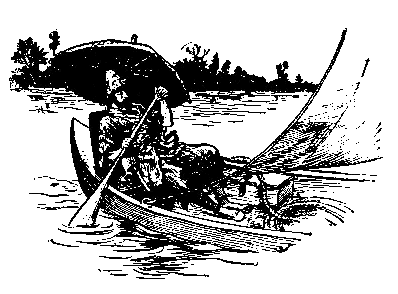
In a few weeks the little vessel was finished (через несколько недель маленькое судно было готово). It was a very pretty canoe (это было красивое каноэ), and large enough for only two or three persons (и достаточно большое только для двух или трех человек).
Small as it was (маленькое, каким оно было = хотя оно было таким маленьким), it was quite heavy (оно было довольно тяжелым). For you must remember that it was a part of the tree (так как вы должны помнить, что это была часть дерева), hollowed out and shaped like a boat (выдолбленная внутри в форме лодки). It was as much as I could do to lift one end of it (все, что я мог сделать, это поднять один конец его /каноэ/).
How should I ever get it to the river (как я должен когда-либо доставить его к реке = как же мне было доставить его к реке)?
I have already told you that I had made plans for this (я уже говорил вам, что я подготовил планы для этого = уже продумал, как это сделать).
Through the soft ground between the river and the canoe I dug a big ditch (в мягкой земле между рекой и каноэ я прокопал большую канаву; through — сквозь, через; to dig — копать). It was four feet deep and six feet wide (она была четыре фута глубиной и шесть футов шириной) and nearly half a mile long (и почти полмили длиной).
I worked at this ditch for nearly two years (я работал над этой канавой почти два года). When it was done and filled with water from the river (когда она была закончена: «сделана» и наполнена водой из реки), I slid my canoe into it (я спустил мое каноэ в нее). It floated (оно поплыло), as I knew it would (как я и думал, что он будет = сделает).
As I pushed it along to the end of the great ditch and out into the river, it looked very small (когда я протолкал его до конца большой канавы и в реку, оно выглядело очень маленьким). I could never hope to make a long voyage in it (я вовсе не мог надеяться совершить большое путешествие на нем; long — длинный; долгий, длительный)!
But I could sail round the island (но я мог ходить под парусом вокруг острова), and make little journeys close to the shore (и совершать маленькие путешествия близко к берегу).
Before starting out (прежде чем отправиться), I put up a mast in the prow of the canoe (я установил мачту на носу каноэ) and made a sail for it of a piece of the ship's sail that I had kept with great care (и сделал парус для нее из куска корабельного паруса, который я хранил с большой заботой).
Then at each end of the little vessel I made lockers or small boxes (на каждой оконечности маленького судна я сделал отсеки, или маленькие ящики; locker — запирающийся шкафчик; ящик; рундук; to lock — запирать ключом, запирать на замок; lock — замок), in which I put a supply of food (в которые я поместил припасы еды) and other things that I would need on my voyage (и другие вещи, которые могли пригодиться мне во время путешествия).
On the inside of the vessel (внутри судна) I cut a little, long, hollow place or shelf (я вырезал маленькую длинную полость, или полку) where I could lay my gun (куда я мог положить ружье); and above this I tacked a long flap of goatskin (а над ней прикрепил большой кусок козьей шкуры; tack — гвоздик с широкой шляпкой; кнопка; to tack — прикреплять гвоздиками, кнопками, клепками; flap — хлопок, шлепок, удар /чем-л. гибким и широким/; нечто широкое, плоское, свободно свешивающееся, болтающееся; широкий, плоский кусок или часть /любого материала/; to flap — хлопать, шлепать, ударять /чем-л. гибким и широким/) to hang down over it and keep it dry (чтобы она свисала над ним и сохраняла его сухим).
In the stern I set up my umbrella (на корме я установил зонтик), so that it would keep the hot sun off of me while I was steering the canoe (так, чтобы он защищал меня от солнца, пока я правил каноэ).
Then every day I made short trips (затем каждый день я совершал короткие путешествия) down the river to the sea and back again (вниз по реке к морю и обратно: «и обратно снова»). Sometimes, when the wind was fair (иногда, когда ветер был попутным), I sailed a little way out (я выходил немного в море); but I was afraid to go far (но я боялся выходить далеко).
At last I made up my mind for a voyage around the island (в конце концов я решил /совершить/ путешествие вокруг острова).
I filled my lockers with food (я наполнил ящики едой). In one I put two dozen barley cakes (в один я положил две дюжины ячменных лепешек) and a pot full of parched rice (и горшок, полный поджаренного риса; to parch — слегка поджаривать, подрумянивать). In the other I stored the hind quarters of a goat (в другой я положил заднюю часть /бёдра/ козы; quarter — четверть, четвертая часть; задняя часть /животного/; hind quarters — задняя часть /туши/).
I also put in powder and shot enough to kill as much game as I would need (я также положил достаточно пороха и дроби, чтобы убить так много дичи, сколько бы мне понадобилось).
On a day in November I set sail on my voyage (в один ноябрьский день я отправился в плавание: «поставил парус»; to set sail — отправляться в плавание). It proved to be a harder voyage than I had bargained for (оно оказалось более тяжелым, чем я ожидал; to bargain — торговаться, заключать сделку; рассчитывать).
In the first place (во-первых), there were so many rocks along the shore (было столь много скал/рифов вдоль берега) that I sometimes had to sail for miles out into the sea to get around them (что я иногда должен был выходить на несколько миль в море, чтобы обогнуть их).
Then, when I was on the farther side of the island (затем = к тому же/во-вторых, когда я был на дальней стороне острова), I struck a furious current of water (я наткнулся на быстрый поток воды; to strike — ударять; направляться, сворачивать; furious — взбешенный, неистовый, яростный; fury — неистовство; бешенство, ярость) that was pouring round a point of land like the sluice of mill (который лился = бурлил вокруг возвышения земли, как водовод мельницы; sluice — шлюз; перемычка; ворота шлюза; канал, водовод).
I could do nothing in such a current (я не мог ничего делать в таком течении). My canoe was whirled along like a leaf in a whirlwind (мое каноэ крутило, как листок в вихре; to whirl — вертеться; кружиться). The sail was of no use (парус был бесполезным). The little vessel spun round and round in the eddies (это маленькое судно вертелось в воронках; to spin — прясть, сучить /шерсть/; крутиться, вертеться, выписывать круги) and was carried far out to sea (и было вынесено далеко в море).
I gave myself up for lost (я сдался и думал, что пропал). I was so far out that I could hardly see the low shores of my island (я был так далеко в открытом море, что едва мог видеть низкие берега моего острова).
Suddenly I noticed that the canoe was only a little way from the edge of the current (вдруг я заметил, что каноэ было лишь на небольшом расстоянии от края течения). Just beyond it the water was quite calm and smooth (прямо за ним вода была довольно спокойной и ровной; smooth — гладкий).
I took up my paddle again (я взял весло опять) and paddled with all my might (и греб со всей своей силой). With great joy I soon found myself floating in quiet water (к большой радости я вскоре обнаружил себя плывущим в тихой воде; to float — плавать; держаться на поверхности воды).
The wind was fair for the shore (ветер дул к берегу), and I set my sail again (и я вновь поднял парус). The canoe sped swiftly back toward the island (каноэ поспешило быстро назад к острову; to speed — двигаться поспешно; мчаться).
I saw then that I was sailing midway between two strong currents (я увидел затем, что я плыл посредине между двумя сильными течениями). If I should be caught in either (если бы я попал: «был пойман» в одно из них; to catch — ловить), I would again be carried out to sea (я бы опять был вынесен в море).
I needed all the skill I had to steer the canoe aright (мне нужно было все мое умение, которое у меня было, чтобы направить каноэ в нужном направлении; aright — верно, правильно). At last, when the sun was almost down (наконец, когда солнце почти зашло), I brought it into a quiet little cove (я завел его в маленькую бухточку) where the shore was green with grass (где берег был зеленым от травы).
perilous ['perIlqs], given ['gIv(q)n], idea [aI'dIq], trial ['traIql], failure ['feIljq], succeed [sqk'sJd], person [pq:sn], river ['rIvq], supply [sq'plaI], afraid [q'freId], furious ['fjuqrIqs], current ['kAr(q)nt], sluice [slu:s], whirl [wq:l], edge [eG], calm [kQ:m]
I HAVE A PERILOUS ADVENTURE
I HAD never given up the idea of having a canoe.
My first trial, as you have seen, was a failure. I had made too big a boat, and I had made it too far from the water. I could do better another time. One day after I had harvested my grain, I set to work.
There was no tree near the river that was fit for a canoe. But I found a fine one nearly half a mile away.
Before I began to chop the tree, I made all my plans for taking the canoe to the water.
I worked now with a will, for I felt sure that I would succeed.
In a few weeks the little vessel was finished. It was a very pretty canoe, and large enough for only two or three persons.
Small as it was, it was quite heavy. For you must remember that it was a part of the tree, hollowed out and shaped like a boat. It was as much as I could do to lift one end of it.
How should I ever get it to the river?
I have already told you that I had made plans for this.
Through the soft ground between the river and the canoe I dug a big ditch. It was four feet deep and six feet wide and nearly half a mile long.
I worked at this ditch for nearly two years. When it was done and filled with water from the river, I slid my canoe into it. It floated, as I knew it would.
As I pushed it along to the end of the great ditch and out into the river, it looked very small. I could never hope to make a long voyage in it!
But I could sail round the island, and make little journeys close to the shore.
Before starting out, I put up a mast in the prow of the canoe and made a sail for it of a piece of the ship's sail that I had kept with great care.
Then at each end of the little vessel I made lockers or small boxes, in which I put a supply of food and other things that I would need on my voyage.
On the inside of the vessel I cut a little, long, hollow place or shelf where I could lay my gun; and above this I tacked a long flap of goatskin to hang down over it and keep it dry.
In the stern I set up my umbrella, so that it would keep the hot sun off of me while I was steering the canoe.
Then every day I made short trips down the river to the sea and back again. Sometimes, when the wind was fair, I sailed a little way out; but I was afraid to go far.
At last I made up my mind for a voyage around the island.
I filled my lockers with food. In one I put two dozen barley cakes and a pot full of parched rice. In the other I stored the hind quarters of a goat.
I also put in powder and shot enough to kill as much game as I would need.
On a day in November I set sail on my voyage. It proved to be a harder voyage than I had bargained for.
In the first place, there were so many rocks along the shore that I sometimes had to sail for miles out into the sea to get around them.
Then, when I was on the farther side of the island, I struck a furious current of water that was pouring round a point of land like the sluice of mill.
I could do nothing in such a current. My canoe was whirled along like a leaf in a whirlwind. The sail was of no use. The little vessel spun round and round in the eddies and was carried far out to sea.
I gave myself up for lost. I was so far out that I could hardly see the low shores of my island.
Suddenly I noticed that the canoe was only a little way from the edge of the current. Just beyond it the water was quite calm and smooth.
I took up my paddle again and paddled with all my might. With great joy I soon found myself floating in quiet water.
The wind was fair for the shore, and I set my sail again. The canoe sped swiftly back toward the island.
I saw then that I was sailing midway between two strong currents. If I should be caught in either, I would again be carried out to sea.
I needed all the skill I had to steer the canoe aright. At last, when the sun was almost down, I brought it into a quiet little cove where the shore was green with grass.
I AM ALARMED BY A VOICE (я разбужен голосом; alarm — боевая тревога, сигнал тревоги; to alarm — поднять тревогу, дать сигнал тревоги; предупредить об опасности; встревожить, взволновать; напугать; насторожить; вызвать тревогу)
AS soon as I touched the land (как только я коснулся земли), I fell upon my knees and gave God thanks for bringing me safe out of so great danger (я пал на колени и возблагодарил Бога: «отдал Богу благодарности» за то, что он вывел меня живым из такой большой опасности).
I made the canoe fast to a rock by the shore (привязал каноэ к скале у берега; fast — крепкий, твердый), and lay down on the grass (и лег на траву).
I was so tired (я был таким уставшим) that I soon fell asleep (что скоро заснул) and did not waken once until the next morning (и не просыпался до следующего утра).
I went up a little hill close by the shore (я поднялся по маленькому холму /расположенному/ близко к берегу), and looked around to see what part of the island I was in (и осмотрелся вокруг, чтобы увидеть, в какой части острова я был).
To my right I saw some well-known trees (справа я увидел хорошо известные деревья) which I had visited when I was exploring the island (которые я посетил = видел, когда исследовал остров). Then I knew that I was only a little way from my summer house (тогда я понял, что я был всего лишь на небольшом расстоянии от моего летнего дома) and that I could reach it easily by walking (и мог легко достичь его пешком).
I was sick of the sea (я устал от моря; sick — больной; пресыщенный; уставший /of — от чего-л./), and I thought that nothing would be so pleasant as a few days in my quiet bower (и я подумал, что ничто не было бы столь приятно, как несколько дней в моей тихой беседке).
So, with my umbrella over my head (поэтому, с зонтом над головой), I started across the country (я отправился через местность). It was a hot day (был жаркий день), and I walked slowly (и я шел медленно).
I stopped often to rest (я часто останавливался отдохнуть), and did not reach my summer house until it was growing dark (и достиг дома, лишь когда стало темнеть: «и не достиг дома, пока стало темнеть»).
I saw that everything was standing just as I had left it (я увидел, что все было таким, как я оставил его: «все стояло точно так, как…»); for I always kept it in good order (так как я всегда содержал его = все вещи в хорошем порядке).
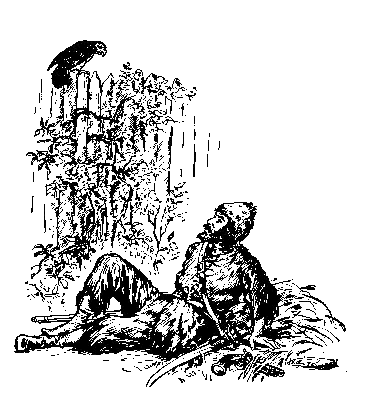
As soon as I got over the fence (как только я перелез через забор; to get over — перейти, перелезть, переправиться /через/), I sat down to rest (я сел отдохнуть); and I was so tired that I fell asleep (и был таким уставшим, что заснул).
Then, all at once in the darkness (затем вдруг в темноте), I heard a voice calling me (я услышал голос, зовущий меня), "Robin, Robin, Robin Crusoe!"
I was so full of sleep (я так крепко спал: «был столь полон сна») that I did not wake up at once (что не проснулся сразу). But between sleeping and waking I could hear somebody saying (но между сном и бодрствованием я мог слышать, как кто-то говорит), "Robin Crusoe, Robin Crusoe!"
I wondered who it could be (я задавался вопросом, кто это мог быть), but I was still more than half asleep (но я все еще спал).
Then the voice screamed in my ear (затем голос крикнул в ухо), "ROBIN CRUSOE!"
I sprang to my feet (я вскочил на ноги; to spring — прыгать, скакать). I was frightened almost out of my wits (я был напуган почти до безумия; wit /часто множ. ч./ — ум, разум). Who in the world could be speaking my name in that place (кто в мире мог произносить мое имя в этом месте)?
No sooner were my eyes well open (как только мои глаза совершенно раскрылись: «были вполне открыты»; no sooner … than — не раньше, чем = как только) than I saw in the dim light of the moon (я увидел при тусклом свете луны) my Poll Parrot (моего попугая Попку) sitting on a post quite close to my shoulder (сидящего на колышке довольно близко к моему плечу).
"Poor Robin Crusoe (бедный Робин Крузо)," he said. "Poor Robin Crusoe."
He was looking down at me as though in pity (он смотрел на веня вниз, как будто сжалившись: «словно в жалости»).
He was but repeating the words I had taught him (он всего лишь повторял слова, которым я его научил). I knew that he was glad to see me (я знал, что он рад видеть меня), as I also was glad to see him (равно как и я был рад видеть его).
I let him sit on my thumb (я позволил ему сесть на мой большой палец) as he often did at home (как он часто делал дома). He rubbed his bill on my face (он потер своим клювом о мое лицо) and kept saying (и продолжал говорить): "Poor Robin Crusoe! Where are you (где ты)? Where have you been (где ты был)?" and other words that he knew (и другие слова, которые он знал).
I wondered how the bird had come to this place (я задавался вопросом, как птица попала в это место), for I had left him at the castle (ведь я оставил его в замке). I asked him (я спросил его); "Why are you here, Poll (почему ты здесь, Попка)?"
But he answered me only by saying (но он отвечал мне только, говоря): "Poor Robin Crusoe! Where have you been?"
I surely believe that the bird loved me (я несомненно верю, что птица любила меня; surely — конечно, несомненно).
In the morning I carried him with me back to my castle (утром я взял: «отнес» его с собой обратно в замок).
As for the canoe (что касается каноэ), I would gladly have brought it back to its place in the little river (я бы с радостью привел его обратно к тому месту на маленькой реке). But I was afraid of being caught again in the furious currents (но я боялся, что вновь попаду в те неистовые потоки: «был боящимся оказаться схваченным/захваченным»; to catch — ловить); and so I left it in the safe cove on the other side of the island (и потому оставил его в безопасной бухточке на другой стороне острова).
alarm [q'lQ:m], voice ['vOIs], touch [tAtS], knee [ni:], thumb [TAm]
I AM ALARMED BY A VOICE
AS soon as I touched the land, I fell upon my knees and gave God thanks for bringing me safe out of so great danger. I made the canoe fast to a rock by the shore, and lay down on the grass.
I was so tired that I soon fell asleep and did not waken once until the next morning.
I went up a little hill close by the shore, and looked around to see what part of the island I was in.
To my right I saw some well-known trees which I had visited when I was exploring the island. Then I knew that I was only a little way from my summer house and that I could reach it easily by walking.
I was sick of the sea, and I thought that nothing would be so pleasant as a few days in my quiet bower.
So, with my umbrella over my head, I started across the country. It was a hot day, and I walked slowly.
I stopped often to rest, and did not reach my summer house until it was growing dark.
I saw that everything was standing just as I had left it; for I always kept it in good order.
As soon as I got over the fence, I sat down to rest; and I was so tired that I fell asleep.
Then, all at once in the darkness, I heard a voice calling me, "Robin, Robin, Robin Crusoe!"
I was so full of sleep that I did not wake up at once. But between sleeping and waking I could hear somebody saying, "Robin Crusoe, Robin Crusoe!"
I wondered who it could be, but I was still more than half asleep.
Then the voice screamed in my ear, "ROBIN CRUSOE!"
I sprang to my feet. I was frightened almost out of my wits. Who in the world could be speaking my name in that place?
No sooner were my eyes well open than I saw in the dim light of the moon my Poll Parrot sitting on a post quite close to my shoulder.
"Poor Robin Crusoe," he said. "Poor Robin Crusoe."
He was looking down at me as though in pity.
He was but repeating the words I had taught him. I knew that he was glad to see me, as I also was glad to see him.
I let him sit on my thumb as he often did at home. He rubbed his bill on my face and kept saying: "Poor Robin Crusoe! Where are you? Where have you been?" and other words that he knew.
I wondered how the bird had come to this place, for I had left him at the castle. I asked him; "Why are you here, Poll?"
But he answered me only by saying: "Poor Robin Crusoe! Where have you been?"
I surely believe that the bird loved me.
In the morning I carried him with me back to my castle.
As for the canoe, I would gladly have brought it back to its place in the little river. But I was afraid of being caught again in the furious currents; and so I left it in the safe cove on the other side of the island.
I AM HAPPY AS A KING (я счастлив как король)
I HAD now had adventures enough for a time (у меня было достаточно приключений пока = уже достаточно приключений), and I felt very happy to be at home with my goats and other pets (и я чувствовал себя очень счастливым быть дома с моими козами и другими питомцами).
A few years before (несколькими годами ранее), I had started with keeping three kids that I had caught (я начал с содержания трех козлят, которых я поймал; to catch — ловить). Now I had a herd of three and forty goats (теперь у меня было стадо из сорока трех коз), some of them young, some old (некоторые из них /были/ старые, некоторые молодые).
I kept them in five little fields that I had fenced (я содержал их в пяти маленьких полях, которые я огородил; to keep — держать, не отдавать; хранить; сохранять; беречь; содержать; держать /животное/), at the foot of my castle hill (у подножия моего холма с замком). I never had any lack of meat and I had plenty of milk, too (у меня никогда не было недостатка в мясе и и было к тому же много молока).
Indeed (на самом деле), I had gone so far as to set up a little dairy (я зашел так далеко, что устроил небольшую маслобойню; to set up — воздвигать, устанавливать, ставить; основывать, открывать /дело, предприятие и т. п./), and sometimes my goats gave me a gallon or two of milk in a day (и подчас мои козы давали мне галлон7 или два молока в день).
Before coming to the island I had never milked a cow (до того, как я прибыл на остров, я никогда не доил корову), much less a goat (тем более: «гораздо менее» козу = не говоря уж о козе). I had never seen butter made (я никогда не видел, как делается масло), or even cheese (или даже сыр). But I learned how to do everything of the kind (я научился, как делать все эти вещи; kind — сорт, разновидность; разряд; вид, класс, род). And now I had more butter and cheese than I could eat (и теперь у меня было больше масла и сыра, чем я мог съесть).
After dinner it was my custom to go out for a stroll (после обеда у меня была привычка выходить на прогулку). How proud I was of my little kingdom (как я гордился: «как горд был» своим маленьким королевством)!
If you had seen me then (если бы вы увидели меня тогда), you would not have laughed (вы не посмеялись бы). You would have been frightened (вы испугались бы). For a stranger-looking fellow you never saw (ибо более странно выглядящего человека вы никогда не видели; fellow — приятель, товарищ, коллега, собрат; /разг./ человек, парень).
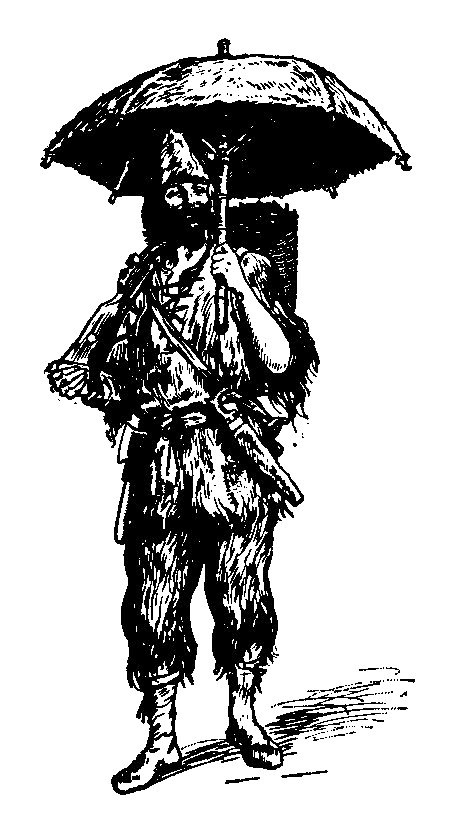
Be pleased to take a picture of me (пожалуйста, «возьмите» описание меня = вот вам…).
On my head was a big cap made of goatskin (на моей голове была большая шапка, сделанная из козьей шкуры). It was very tall and without shape (она была очень высокая и без формы). A flap hung down from the back of it to keep the rain off my neck (лоскут свисал с нее назад, чтобы оберегать шею от дождя).
I wore a short jacket of goatskin (короткая куртка из козьей шкуры) and a pair of knee breeches of the same (и бриджи из того же /материала/).
I had neither stockings nor shoes (у меня не было ни чулок, ни туфель/башмаков). But I wore around my legs and feet some queer things (я носил вокруг ног и ступней странные вещи; to wear — носить /одежду, обувь/) that I called buskins (которые я называл баскинами; buskins — высокие башмаки со шнуровкой на толстой подошве). They were made of goatskin, too (они были сделаны из козьей шкуры, также), and were of great use when walking among briers or stones (и были очень удобны при ходьбе между кустами и камнями; brier — колючий кустарник).
Around my waist I had a broad belt of rawhide (вокруг талии у меня был широкий пояс из сыромятной кожи; raw — сырой; необработанный; hide — кожа, шкура). I had no need of sword or dagger (мне не требовался ни меч, ни кинжал); and so I carried in this belt a little saw and a hatchet (и потому я носил в этом поясе маленькую пилу и топорик).
Another belt, which hung over my shoulder (другой ремень, который висел на плече), held my powderhorn and shot pouch (держал рог с порохом и мешочек с дробью).
On my back was slung a basket (на спине висела корзина; to sling — бросать, швырять; вешать через плечо). On my shoulder was my gun (на плече было мое ружье). Above my head I carried my great clumsy, ugly umbrella (над головой я носил мой большой грубый, уродливый зонт; clumsy — неловкий; топорный, неаккуратно сделанный).
My face was as dark as mahogany (мое лицо было темным, как красное дерево). It was tanned by the sun and browned by the hot winds (оно было смуглым от солнца и загорелым от горячих ветров; to tan — дубить /кожу/; обжигать кожу /о солнце/).
My beard was at one time a yard long (борода была одно время ярд8 длиной). But I soon grew tired of it (но я вскоре устал от нее = вскоре она надоела мне) and cut it pretty short (и я обрезал ее довольно коротко; to cut — резать). Yet even then it looked grizzly enough (и все же даже тогда она выглядела довольно седой; grizzly — серый; с сильной проседью), I assure you (уверяю вас).
It is not a very handsome picture (не очень красивая картинка), is it (не так ли)?
But do not blame me (не вините меня). I dressed as well as I could (я одевался так, как мог). I kept myself clean (я содержал себя в чистоте). I tried to be worthy of respect (я старался быть достойным уважения), even though no one saw me (даже хотя никто не видел меня).
I looked over my little kingdom (я смотрел на/осматривал мое королевство) and was proud and happy (и был горд и счастлив).
You would have laughed to see me and my family when dinner time came (вы бы посмеялись, видя меня и мое семейство, когда приходило время обеда).
First there was myself (во-первых, вот я сам), Robinson Crusoe, king of the island (король острова). I was the lord of everything I could see (я был повелителем всего, что я мог видеть).
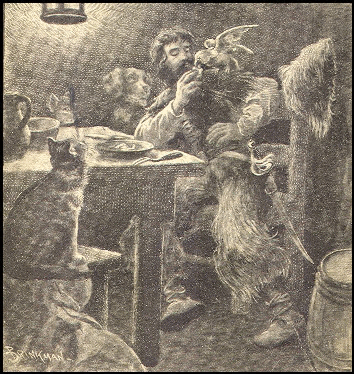
Then, like a king (затем = во-вторых, подобно королю), I dined alone (я ел один), with my servants looking on (со слугами, смотрящими на /меня/).
No one was allowed to talk to me but Poll Parrot (никому не было позволено говорить со мной, кроме попугая Попки), who sat on the back of my chair (который сидел на спинке стула) and waited for what I would give him (и ждал того, что я ему дам).
My dog was now so old and feeble (мой пес был теперь столь старым и немощным) that he could hardly stir (что едва мог пошевелиться). He sat always at my right hand (он сидел всегда по правую руку от меня) and wagged his tail if I did but snap my finger (и вилял хвостом, стоило мне щелкнуть пальцем: «если я лишь щелкал пальцем»).
My two cats waited (мои две кошки ждали), one on each side of the table (одна на каждой стороне от стола = каждая со своей стороны стола), to see what I would give them (ожидая подачки: «чтобы увидеть, что я им дам»).
These two cats were not the same that I had brought from the ship (эти две коши были не те же самые, которых я принес с корабля). Those were dead (те умерли: «были мертвы»), long ago (/уже/ давно), of old age (от старости: «от старого возраста»). But they had left many kittens (но они оставили много котят; to leave — оставлять).
Indeed (в самом деле), there had come to be so many cats that I was forced to drive them away (оказалось: «случилось быть» так много кошек, что я был вынужден выгнать их; to drive — гнать; to drive away — гнать прочь, выгонять, отгонять). All but these two had gone into the woods (все, кроме этих двух, ушли в леса) and become very wild (и стали очень дикими).
adventure [qd'ventSq], young [jAN], old ['quld], dairy ['deqrI], gallon ['gxlqn], stroll ['strqul], kingdom ['kINdqm], picture ['pIktSq], mahogany [mq'hOg(q)nI], assure [q'Suq], servant ['sq:vqnt], dead [ded], ago [q'gqu]
I AM HAPPY AS A KING
I HAD now had adventures enough for a time, and I felt very happy to be at home with my goats and other pets.
A few years before, I had started with keeping three kids that I had caught. Now I had a herd of three and forty goats, some of them young, some old.
I kept them in five little fields that I had fenced, at the foot of my castle hill. I never had any lack of meat and I had plenty of milk, too.
Indeed, I had gone so far as to set up a little dairy, and sometimes my goats gave me a gallon or two of milk in a day.
Before coming to the island I had never milked a cow, much less a goat. I had never seen butter made, or even cheese. But I learned how to do everything of the kind. And now I had more butter and cheese than I could eat.
After dinner it was my custom to go out for a stroll. How proud I was of my little kingdom!
If you had seen me then, you would not have laughed. You would have been frightened. For a stranger-looking fellow you never saw.
Be pleased to take a picture of me.
On my head was a big cap made of goatskin. It was very tall and without shape. A flap hung down from the back of it to keep the rain off my neck.
I wore a short jacket of goatskin and a pair of knee breeches of the same.
I had neither stockings nor shoes. But I wore around my legs and feet some queer things that I called buskins. They were made of goatskin, too, and were of great use when walking among briers or stones.
Around my waist I had a broad belt of rawhide. I had no need of sword or dagger; and so I carried in this belt a little saw and a hatchet.
Another belt, which hung over my shoulder, held my powderhorn and shot pouch.
On my back was slung a basket. On my shoulder was my gun. Above my head I carried my great clumsy, ugly umbrella.
My face was as dark as mahogany. It was tanned by the sun and browned by the hot winds.
My beard was at one time a yard long. But I soon grew tired of it and cut it pretty short. Yet even then it looked grizzly enough, I assure you.
It is not a very handsome picture, is it?
But do not blame me. I dressed as well as I could. I kept myself clean. I tried to be worthy of respect, even though no one saw me.
I looked over my little kingdom and was proud and happy.
You would have laughed to see me and my family when dinner time came.
First there was myself, Robinson Crusoe, king of the island. I was the lord of everything I could see.
Then, like a king, I dined alone, with my servants looking on.
No one was allowed to talk to me but Poll Parrot, who sat on the back of my chair and waited for what I would give him.
My dog was now so old and feeble that he could hardly stir. He sat always at my right hand and wagged his tail if I did but snap my finger.
My two cats waited, one on each side of the table, to see what I would give them.
These two cats were not the same that I had brought from the ship. Those were dead, long ago, of old age. But they had left many kittens.
Indeed, there had come to be so many cats that I was forced to drive them away. All but these two had gone into the woods and become very wild.
I LEARN TO BAKE AND AM PROSPEROUS (я учусь печь, и я процветаю; prosperous — процветающий, преуспевающий; удачливый)
I HAVE already told you about farming (я уже рассказал вам о фермерстве), and of the difficulties under which I did my work (и о сложностях, с которыми: «под которыми» я делал свою работу = которые возникали в моей работе). The thing which I wished to do most of all to make good bread (вещь, которую я хотел сделать больше всего, — сделать хороший хлеб).
I tried many plans, but it was several years before I could think of myself as a really good baker (я испробовал много планов, но прошло несколько лет, прежде чем я мог думать о себе как о действительно хорошем пекаре = считать себя действительно хорошим пекарем).
My barley was very fine (мой ячмень был очень хорош). The grains were large and smooth (зерна были большими и гладкими). When boiled a long time with a bit of goat's meat (при варке в течение долгого времени с куском козьего мяса), they made good food (они были хорошей едой: «делали = составляли хорошую еду»).
But they did not take the place of bread (но они не заменяли: «не занимали место» хлеба). Before bread could be made, the grains of barley must be ground into meal (прежде чем хлеб может быть сделан, зерна ячменя должны быть помолоты в муку; to grind — молоть, перемалывать; растирать /в порошок/; толочь).
I tried pounding them with a stone (я пытался растирать их камнем; to pound — бить, колотить; толочь). But that was slow work (но то была медленная работа). The stone crumbled into sand (камень рассыпался в песок; to crumble— сыпаться, осыпаться; обваливаться). My meal was worth nothing (такая еда не стоила ничего: «была стоящей ничего»).
I looked all over the island for a harder stone (я обыскал весь остров /в поисках/ более твердого камня). All were alike (все были одинаковыми; alike — одинаковый; идентичный, подобный, похожий, тождественный).
So at last I cut a large block of very hard wood (в конце концов я срезал большой кусок очень крепкой древесины). I rounded it on the outside with my hatchet (я закруглил его снаружи топориком). Then, partly by chopping (затем частично рубкой), partly by burning (частично выжиганием), I made a hollow place in the end of it (я сделал полость на конце его).
Out of a piece of ironwood (из куска железного дерева; ironwood — "железное" дерево /термин употребляется для различных древесных пород с твердой тяжелой древесиной/) I made a heavy pestle or beater (я сделал тяжелый пестик, или колотушку).
I had now a very good little mill (теперь у меня была очень хорошая мельница). In a short time I had crushed enough barley to make meal for a large loaf (в короткое время я размолол достаточно ячменя, чтобы сделать муку для большой буханки; loaf — буханка, каравай; булка, батон /порция испеченного хлеба/).
It was easy to make the dough (было легко сделать тесто). I had only to mix the meal with water and knead it with my hands (мне нужно было лишь смешать муку с водой и размять ее руками). I must not think of yeast to make the dough light (мне не приходилось думать о дрожжах, чтобы сделать тесто легким; light — легкий; /кул./ хорошо поднявшийся, легкий, воздушный /о тесте/).
The baking part was the main thing (выпекание было основным делом), and the hardest to learn (и самым сложным, чтобы научиться = и ему труднее всего было научиться).
At first I put my biscuits of dough in the hot ashes (вначале я клал куски теста в горячие угли) and left them there till they were baked (и оставлял их там, пока не испекутся). But I did not like these ash cakes very well (но мне не нравились эти пироги с золой).
Then I tried another plan (потом я попробовал иной план = попробовал сделать по-другому).
I made two large earthen vessels (я сделал два больших глиняных сосуда; vessel — сосуд /для жидкости/; корабль, судно). They were broad and shallow (они были широкими и неглубокими: «мелкими»). Each was about two feet across and not more than nine inches deep (каждый был около двух футов в ширину и не более девяти дюймов в глубину).
These I burned in the fire (их я обжег на огне) till they were as hard as rocks and as red as tiles (пока они не стали твердыми, как камни, и красными, как черепица).
I made also a hearth before my fireplace (я соорудил также /специальный/ очаг перед местом костра; hearth/fireplace — очаг; камин), and paved it with some square tiles of my own making (и выложил его квадратными черепицами моего собственного изготовления). But, perhaps I ought not to call them square (но, возможно, не стоит их называть квадратными: «я не должен бы…»).
The hearth, when finished, was quite level and smooth (очаг, когда был завершен, был довольно ровным и гладким). It was as pretty as I could have wished (он был таким красивым, как я мог желать).
Next I built a great fire of hard wood (затем я развел большой огонь/костер из твердой древесины). When the wood had burned down (когда дерево прогорело), I raked the hot coals out upon my hearth (я выгреб /из костра/ угли на мой очаг). I left them there till the hearth was hot through and through (я оставил их там, пока очаг не прогрелся основательно).
My loaves of dough were all ready (куски теста были готовы). I swept hearth clean (я вымел очаг дочиста; to sweep — мести) and then put the loaves down upon the hottest part of it (и затем положил куски на самую горячую его часть).
Over each loaf I put one of the large earthen vessels I had made (над каждой буханкой я поставил один из больших глиняных сосудов, которые я сделал). Then I heaped hot coals on the top of the vessel (затем я наложил горячие угли поверх каждого сосуда; to heap — бросать в кучу, складывать в кучу, нагромождать) and all round the sides of it (и вокруг его боков = обложил углями его бока).
In a short time I lifted the vessels and took out my loaves (через короткое время я поднял сосуды и вынул мои буханки; to take out — вынимать). They were baked as well as the best oven in the world could have baked them (они были выпечены так, как лучшая печка в мире выпекла бы их).
By trying and trying again (пробуя/пытаясь вновь и вновь), I at last learned to bake almost everything I wanted (я наконец научился печь почти все, что я хотел). I baked cakes and rice pudding fit for a king (я пек лепешки и рисовый пудинг, годные/подходящие для короля). But I did not care for pies (но я не заботился о пирогах = был равнодушен к пирогам).
I now felt quite contented and prosperous (теперь я чувствовал себя удовлетворенным и процветающим). For did I not have everything that I needed (ибо разве у меня не было всего, что мне нужно)?
I had two homes on the island (у меня было два дома на острове). I called them my plantations (я называл их моими плантациями).
The first of these was my strong castle under the rock (первым из них был мой крепкий замок под скалой). I had enlarged it until my cave contained many rooms (я расширял его, пока моя пещера не стала содержать много комнат), one opening into another (открывающихся = выходящих одна в другую).
The largest and driest of these was my storeroom (самая большая и самая сухая из них была складская комната; dry — сухой; store — склад). Here I kept the largest of my earthen pots (здесь я держал/хранил самые большие из моих глиняных горшков; to keep — хранить; сохранять). Here also were fourteen or fifteen big baskets (здесь были также четырнадцать или пятнадцать больших корзин), all filled with grain (наполненных зерном).
My sitting room was not large (зал был не большим; sitting room — гостиная), but it was made for comfort (но он был сделан для комфорта = обустроен удобно).
As for the wall in front of the castle (что касается стены перед замком), it was a wonderful thing (это была удивительная вещь). The long stakes which I had driven down had all taken root (длинные колья, которые я вбил, все укоренились: «взяли корень»). They had grown like trees (они выросли, как деревья), and were now so big and so thick with branches that it was hard to see between them (и были сейчас такими большими и такими толстыми, с /такими/ ветвями, что было сложно видеть /что-либо/ между ними).
No one passing by (ни один проходящий мимо) would ever think there was a house behind this matted row of trees (никогда бы не подумал, что там был дом за этим переплетенным рядом деревьев; to mat — сбивать, спутывать, сваливать в ком /траву, шерсть и т. п./; плести /циновки, подстилки и т. п./; mat — рогожа; циновка; /спорт./ мат).
Near this dwelling of mine (около этого моего обиталища), but a little farther within the land (только немного дальше вглубь местности), were my two barley fields (были два моих ячменных поля). These I cultivated with care (их я возделывал с заботой), and from them I reaped a good harvest (и с них я получал хороший урожай; to reap — жать, пожинать, собирать урожай). As often as I felt the need of more barley I made my fields larger (как только я чувствовал необходимость в большем количестве ячменя, я расширял свои поля).
Farther away was what I called my country seat (дальше было то, что я называл своим деревенским пристанищем/деревенской резиденцией; seat — сиденье; местонахождение). There was my pleasant summer house or bower (мой приятный/симпатичный летний дом или беседка), where I liked to go for rest (куда мне нравилось уходить отдохнуть; rest — покой, отдых).
In the middle of my bower (в центре беседки) I had my tent always set (для меня всегда был установлен навес). It was made of a piece of sail spread over some poles (он был сделан из куска паруса, натянутого на колья; to spread — развертывать; раскидывать; расстилать).
Under the tent I had made a soft couch (под навесом я устроил мягкую кушетку) with the skins of animals and a blanket thrown over them (из шкур животных и одеяла, накинутого на них; to throw — бросать). Here, when the weather was fair, I often slept at night (здесь я часто спал ночью при хорошей погоде).
A little way from the bower was the field (в некотором удалении от беседки было поле) in which I kept my cattle (на котором я держал мой скот) — that is to say (то есть), my goats (коз).
I had taken great pains to fence and inclose this field (я приложил много труда, чтобы обнести забором и огородить это поле). I was so fearful, lest the goats should break out (я так боялся, как бы козы не вырвались наружу; fearful — испытывающий страх, испуганный; fear — страх), that I worked many a day planting a hedge all around (что я проработал много дней, высаживая /живую/ изгородь вокруг). The hedge grew to be very tall and was as strong as a wall (/живая/ изгородь выросла и стала крепкой, как стена: «чтобы стать крепкой…»; to grow — расти).
On the shore of the sea (на берегу моря), some distance beyond my summer house (на некотором расстоянии от моего летнего дома), was the little inlet where I had laid up my canoe (был /узкий/ залив, где я хранил мое каноэ; to lay up — откладывать, копить; выводить временно из строя).
prosperous ['prOsp(q)rqs], pestle [pesl], dough ['dqu], shallow ['Sxlqu], square ['skweq], hearth [hQ:T], contented [kqn'tentId], enlarge [In'lQ:G, en'lQ:G]
I LEARN TO BAKE AND AM PROSPEROUS
I HAVE already told you about farming, and of the difficulties under which I did my work. The thing which I wished to do most of all to make good bread. I tried many plans, but it was several years before I could think of myself as a really good baker.
My barley was very fine. The grains were large and smooth. When boiled a long time with a bit of goat's meat, they made good food.
But they did not take the place of bread. Before bread could be made, the grains of barley must be ground into meal.
I tried pounding them with a stone. But that was slow work. The stone crumbled into sand. My meal was worth nothing.
I looked all over the island for a harder stone. All were alike.
So at last I cut a large block of very hard wood. I rounded it on the outside with my hatchet. Then, partly by chopping, partly by burning, I made a hollow place in the end of it.
Out of a piece of ironwood I made a heavy pestle or beater.
I had now a very good little mill. In a short time I had crushed enough barley to make meal for a large loaf.
It was easy to make the dough. I had only to mix the meal with water and knead it with my hands. I must not think of yeast to make the dough light.
The baking part was the main thing, and the hardest to learn.
At first I put my biscuits of dough in the hot ashes and left them there till they were baked. But I did not like these ash cakes very well.
Then I tried another plan.
I made two large earthen vessels. They were broad and shallow. Each was about two feet across and not more than nine inches deep.
These I burned in the fire till they were as hard as rocks and as red as tiles.
I made also a hearth before my fireplace, and paved it with some square tiles of my own making. But, perhaps I ought not to call them square.
The hearth, when finished, was quite level and smooth. It was as pretty as I could have wished.
Next I built a great fire of hard wood. When the wood had burned down, I raked the hot coals out upon my hearth. I left them there till the hearth was hot through and through.
My loaves of dough were all ready. I swept hearth clean and then put the loaves down upon the hottest part of it.
Over each loaf I put one of the large earthen vessels I had made. Then I heaped hot coals on the top of the vessel and all round the sides of it.
In a short time I lifted the vessels and took out my loaves. They were baked as well as the best oven in the world could have baked them.
By trying and trying again, I at last learned to bake almost everything I wanted. I baked cakes and rice pudding fit for a king. But I did not care for pies.
I now felt quite contented and prosperous. For did I not have everything that I needed?
I had two homes on the island. I called them my plantations.
The first of these was my strong castle under the rock. I had enlarged it until my cave contained many rooms, one opening into another.
The largest and driest of these was my storeroom. Here I kept the largest of my earthen pots. Here also were fourteen or fifteen big baskets, all filled with grain.
My sitting room was not large, but it was made for comfort.
As for the wall in front of the castle, it was a wonderful thing. The long stakes which I had driven down had all taken root. They had grown like trees, and were now so big and so thick with branches that it was hard to see between them.
No one passing by would ever think there was a house behind this matted row of trees.
Near this dwelling of mine, but a little farther within the land, were my two barley fields. These I cultivated with care, and from them I reaped a good harvest. As often as I felt the need of more barley I made my fields larger.
Farther away was what I called my country seat. There was my pleasant summer house or bower, where I liked to go for rest.
In the middle of my bower I had my tent always set. It was made of a piece of sail spread over some poles.
Under the tent I had made a soft couch with the skins of animals and a blanket thrown over them. Here, when the weather was fair, I often slept at night.
A little way from the bower was the field in which I kept my cattle — that is to say, my goats.
I had taken great pains to fence and inclose this field. I was so fearful, lest the goats should break out, that I worked many a day planting a hedge all around. The hedge grew to be very tall and was as strong as a wall.
On the shore of the sea, some distance beyond my summer house, was the little inlet where I had laid up my canoe.