



I EXPLORE MY ISLAND (я исследую мой остров)
IT rained all that night (дождь шел всю ночь). But in the cave everything was warm and dry (но в пещере все было теплым и сухим), and little by little I lost my fear (и мало-помалу я утратил свой страх; to lose — терять, утрачивать).
The earthquake and the hurricane had done great damage to my castle (землетрясение и ураган причинили большой ущерб моему замку). I had to work hard for many days (мне пришлось усиленно трудиться много дней) to put things to rights again (чтобы привести все в порядок).
I had now been on the island about ten months (я был уже на острове около десяти месяцев). In all that time I had seen only a small part of it (за все это время я видел только малую часть его).
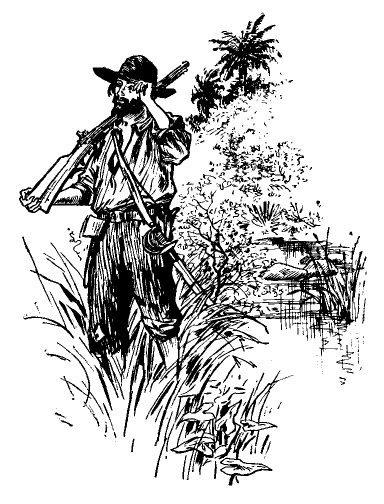
One morning I set out with my gun on my shoulder for a long walk (одним утром я пустился с ружьем на плече на длительную прогулку).
I went up the little river (я прошел вверх вдоль маленькой реки) where I had first landed with my rafts (где я впервые причаливал с моими плотами). I found that it was a very short river (я обнаружил, что это была очень короткая река). After about two miles (через примерно две мили), the tide did not flow any higher (вода не приливала выше); and above that, the stream was only a little brook of fresh water (и над этим /местом/ поток был только маленьким ручьем пресной воды).
Along the brook there were pleasant meadows (вдоль ручья были красивые луга; pleasant — приятный; радостный; милый, симпатичный; славный), covered with high grass (покрытые высокой травой).
In the dryer parts of these meadows (в более сухих частях этих лугов) I found tobacco growing wild (нашел табак, растущий диким = дикорастущий табак).
I looked for the roots of a plant which the Indians use instead of bread (я искал корни /какого-либо/ растения, которое индейцы используют вместо хлеба), but could find none (не мог найти ни одного).
In one place, however (однако в одном месте), I saw many tall sugar canes (я увидел много высоких /растений/ сахарного тростника) and some fair-looking plants of a kind that was strange to me (и несколько красиво выглядящих растений вида, который был незнаком мне).
As I went back to my castle I wondered how I could learn something useful about the many objects I had seen (пока я шел обратно в мой замок, я думал, как я мог узнать = как бы мне узнать что-то полезное о многих объектах, /которые/ я видел). But I had never taken much thought about such things (но я никогда много не думал = не задумывался о подобных вещах), and now I had but little chance to learn (и теперь я имел лишь маленький шанс узнать = не имел особой возможности узнать).
The next day I went up the same way, but much farther (на следующий день я пошел по тому же пути, но намного дальше).
Beyond the meadows I came to some beautiful woods (за лугами я пришел к красивым лесам = обнаружил прекрасный лес).
Here I found several different kinds of fruits (здесь я нашел несколько различных видов фруктов). There were grapevines covering the trees (здесь были виноградные лозы, покрывающие деревья), and huge clusters of ripe grapes were hanging from them (и с них свисали огромные гроздья зрелого винограда).
I was very glad of this (я был очень рад этому). I made up my mind to come another day (я решил прийти в другой день) and gather some of this fruit (и собрать немного винограда: «некоторое количество этого плода»). I would dry the grapes in the sun (я /подумал, что/ высушу виноград на солнце; would — /зд./ вспомогательный глагол; используется для образования будущего в прошедшем во 2 и 3 лице), and have some raisins (и получу изюм).
Night came on (настала ночь) while I was still in the woods (пока я все еще был в лесу), and I could not do better than stay there till morning (и не мог сделать ничего лучше = мне ничего не оставалось, как остаться там до утра). So I climbed into a tree and slept there quite well (поэтому я залез на дерево и поспал там очень хорошо; to sleep — спать).
It was the first night that I had spent away from home (это была первая ночь, которую я провел вне дома; to spend — проводить /время/).
The next day I went on through the woods for nearly four miles (на следующий день я прошел по лесу почти четыре мили; to go on — продолжать идти).
At last I came to an open space where the land sloped to the west (наконец я пришел к открытому пространству, где земля клонилась к западу; slope — наклон, уклон; to slope — клониться; иметь наклон). The country was so fresh and green that it looked like a big garden (местность была такой свежей и зеленой, что выглядела, как большой сад).
I went down into a pleasant valley (я спустился: «пошл вниз» в красивую/приятную долину) where there were many beautiful trees (где было много прекрасных деревьев). There I found oranges, lemons, limes, and citrons (там я обнаружил апельсины, лаймы /маленькие зеленые лимончики/, лимоны), besides many grapes (помимо множества винограда).
I loaded myself with fruit and started homeward (я нагрузил себя фруктами и начал идти = отправился домой). "I must come again and bring a sack (я должен вернуться /сюда/ и принести мешок)," I said.
It was three days before I reached my castle (только через три дня я достиг моего замка: «было три дня, прежде чем…»). By that time the fruit had lost all its flavor (к тому времени плоды потеряли весь свой вкус; to lose — терять, утрачивать).
The next day I went back to the same valley (на следующий день я вернулся: «пошел назад» в ту же самую долину). I carried two small sacks to bring home my harvest (я нес два маленьких мешка, чтобы принести домой мой урожай).
But I found many of the grapevines torn down (но я обнаружил многие лозы сорванными; to tear down — срывать, вырывать; to tear — рвать). The fruit was scattered on the ground (плоды были разбросаны по земле). Some had been eaten (некоторые были съедены). Some had been trodden to pieces (некоторые были растоптаны на куски; to tread — топтать, наступать, давить).
A wild animal had been there (дикое животное побывало там). Perhaps it was a goat (возможно, коза), perhaps it was a larger beast (возможно, это было /какое-то/ животное побольше). Perhaps several animals had done the mischief (возможно, ущерб сделали = нанесли несколько животных; mischief — вред; повреждение; убытки, ущерб).
warm ['wO:m], damage ['dxmIG], put [put], stream [stri:m], meadow ['medqu], [grQ:s], tobacco [tq'bxkqu], plant ['], [plQ:nt], Indian ['IndIqn], [In'sted], none [nAn], however [hau'evq], object ['ObGIkt, 'ObGekt], different ['dIf(q)r(q)nt], fruit [fru:t], raisin ['reIzn], orange ['OrInG], lemon ['], ['lemqn], citron ['sItr(q)n] besides [bI'saIdz], flavor ['fleIvq], valley ['vxlI], harvest ['hQ:vIst], mischief ['mIstSi:f]
I EXPLORE MY ISLAND
IT rained all that night. But in the cave everything was warm and dry, and little by little I lost my fear. The earthquake and the hurricane had done great damage to my castle. I had to work hard for many days to put things to rights again.
I had now been on the island about ten months. In all that time I had seen only a small part of it.
One morning I set out with my gun on my shoulder for a long walk.
I went up the little river where I had first landed with my rafts. I found that it was a very short river. After about two miles, the tide did not flow any higher; and above that, the stream was only a little brook of fresh water.
Along the brook there were pleasant meadows, covered with high grass.
In the dryer parts of these meadows I found tobacco growing wild.
I looked for the roots of a plant which the Indians use instead of bread, but could find none.
In one place, however, I saw many tall sugar canes and some fair-looking plants of a kind that was strange to me.
As I went back to my castle I wondered how I could learn something useful about the many objects I had seen. But I had never taken much thought about such things, and now I had but little chance to learn.
The next day I went up the same way, but much farther.
Beyond the meadows I came to some beautiful woods.
Here I found several different kinds of fruits. There were grapevines covering the trees, and huge clusters of ripe grapes were hanging from them.
I was very glad of this. I made up my mind to come another day and gather some of this fruit. I would dry the grapes in the sun, and have some raisins.
Night came on while I was still in the woods, and I could not do better than stay there till morning. So I climbed into a tree and slept there quite well.
It was the first night that I had spent away from home.
The next day I went on through the woods for nearly four miles.
At last I came to an open space where the land sloped to the west. The country was so fresh and green that it looked like a big garden.
I went down into a pleasant valley where there were many beautiful trees. There I found oranges, lemons, limes, and citrons, besides many grapes.
I loaded myself with fruit and started homeward. "I must come again and bring a sack," I said.
It was three days before I reached my castle. By that time the fruit had lost all its flavor.
The next day I went back to the same valley. I carried two small sacks to bring home my harvest.
But I found many of the grapevines torn down. The fruit was scattered on the ground. Some had been eaten. Some had been trodden to pieces.
A wild animal had been there. Perhaps it was a goat, perhaps it was a larger beast. Perhaps several animals had done the mischief.
I GET READY FOR WINTER (я готовлюсь к зиме)
I WAS so much pleased with the valley I had discovered (я был так доволен этой долиной, /которую/ я открыл) that I spent much of my time there (что проводил большую часть времени там; to spend — проводить /время/).
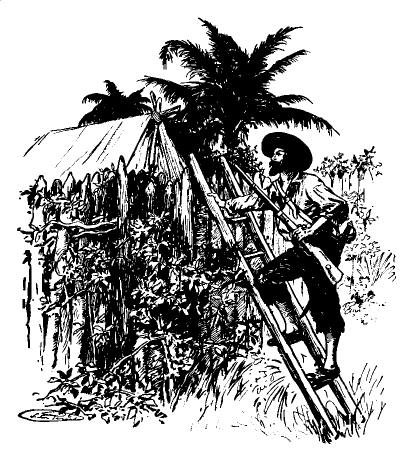
At last I built me a small summer house (наконец я построил себе маленький летний домик) close by a grove of orange trees (близко к роще апельсиновых деревьев).
It was but little more than a bower (он был лишь немного больше, чем беседка; bower — дача, коттедж; беседка), made of the branches of trees (сделанная из веток деревьев).
I built a strong fence around it (я соорудил крепкий забор вокруг него; to build — строить). This was made of two rows of tall stakes (он был сделан из двух рядов высоких кольев) with brushwood between (с ветками между /ними/; brushwood — подлесок, молодая поросль, заросли; кустарник; валежник, хворост).
There was no gate in this fence (в этом заборе не было калитки; gate — ворота /как сооружение/; дверь, ворота, калитка), but only a short ladder (но только короткая лестница), just as at my castle (совсем как в моем замке).
Here I sometimes stayed two or three nights together (здесь я иногда оставался на две или три ночи кряду).
I gathered about two hundred clusters of grapes and hung them up to dry (я собрал почти двести гроздьев винограда и повесил их сушиться; to hang — вешать). In due time (в должное время) they made the finest of raisins (из них сделался самый вкусный изюм). I took them down and carried them to my castle (я снял их и отнес в мой замок).
Thus little by little I gathered food for winter (так/таким образом мало-помалу я собрал еду на зиму).
The winters there were not cold (зимы там были не холодные). But the rain fell every day (но дождь падал = шел каждый день), and often all the day (и часто весь день).
I had just finished my bower (я только что закончил беседку/летний домик), and was beginning to enjoy myself (и начал наслаждаться = жить припеваючи; to enjoy smth. — получать удовольствие от чего-л.; to enjoy oneself — хорошо проводить время) when the rainy season or winter, began (когда = как начался сезон дождей, или зима,).
What could I do but hurry back to my castle and its dry, warm cave (что я мог сделать, кроме как поторопиться обратно в замок и в его сухую, теплую пещеру)?
For weeks I could not stir out without getting wet (неделями я не мог выйти, не намокнув; to stir — шевелиться, двигаться). My store of food began to grow small (мои запасы еды начали сокращаться: «становиться малыми»).
One day, in spite of the rain (однажды, несмотря на дождь), I went out and killed a goat (я вышел и убил козу). The next day I found a very large turtle among the rocks (на следующий день я нашел очень большую черепаху среди /больших/ камней).
This was all good luck (это все была удача), for I had now enough to eat for many a day (так как теперь у меня было достаточно еды: «достаточно, чтобы есть» на много дней).
My meals were simple and plain (мои приемы пищи были простыми и неразнообразными = моя еда была…; plain — /уст./ плоский, ровный; незамысловатый, обыкновенный; meal — прием пищи; еда).
For breakfast, I had a bunch of raisins and a bit of biscuit (на завтрак я ел горсть изюма и кусок печенья).
For dinner, I had broiled turtle (на обед у меня была жареная черепаха). I could not have turtle soup (я не мог приготовить суп из черепахи), for I had no vessel in which to cook it (так как у меня не было сосуда, в котором приготовить его).
For supper, I ate two or three turtle's eggs (на ужин я съедал два или три черепашьих яйца; to eat — есть).
Although I was kept close indoors by the rain (хотя дождь вынуждал меня оставаться внутри дома: «я был удерживаем заключенным в помещение дождем»; indoors — внутри дома, в помещении; door — дверь; close — закрытый; заключенный /в тюрьму и т. п./, строго охраняемый), I was never idle (я никогда не был без дела; idle — праздный).
Every day I worked at making my cave larger (каждый день я трудился над тем, чтобы сделать мою пещеру больше). I dug far in (я копал дальше; to dig — копать), behind the rock (за скалой), and made a fine, large room there (и сделал там прекрасную, большую комнату).
Then I made another door or way out (затем я сделал другую дверь или выход), which opened on the outside of my wall (которая открывалась снаружи моей стены = в моей стене). So now I could come into the castle through the cellar (так что я мог входить в замок через погреб), or kitchen (или кухню), and without climbing the ladder (и не взбираясь по лестнице).
This was much handier and easier than the other way (это было намного удобнее и легче, чем наоборот; handy — доступный; близкий, /имеющийся/ под рукой; удобный /для пользования/). But it did not seem so safe (но это не казалось таким безопасным). I feared now lest some wild beast might get into my house (я боялся, как бы дикие животные не смогли попасть в мой дом); and yet the biggest animal (хотя самым большим животным) I had seen on the island was a goat (/которое/ я видел на острове, была коза).
Soon after this I put a roof over my whole inclosure (вскоре после этого я поместил крышу над всем своим убежищем; inclosure/enclosure — огороженное место). I took a number of long poles for rafters (я взял несколько длинных шестов в качестве стропил) and laid one end of each on the wall (и положил один конец каждого /стропила/ на стену; to lay — класть), while the other end leaned against the rock above the cave (в то время как другой конец опирался на скалу над пещерой).
These I covered with boughs of trees (их я покрыл ветками деревьев), long grass (длинной травой), and such other things as I could get (и подобными другими вещами, которые мог достать). In this way I made a very good roof which turned the rain and kept everything dry (так/таким образом я сделал очень хорошую крышу, которая отклоняла дождь = защищала от дождя и сохраняла все сухим).
My castle was now a very roomy place (мой замок был теперь очень просторным местом; room — место, пространство; помещение). It was quite warm and dry even in the worst of weather (оно было довольно теплым и сухим даже в самую плохую погоду; worst — худший; the worst — самое худшее).
discover [dI'skAvq], grove ['grquv], bower ['bauq], brushwood ['brASwud], between [bI'twJn], enjoy [In'GOI], myself [maI'self], season [si:zn], bunch [bAntS], turtle [tq:tl], soup [su:p], indoors ["In'dO:z], idle ['aIdl], roof [ru:f]
I GET READY FOR WINTER
I WAS so much pleased with the valley I had discovered that I spent much of my time there. At last I built me a small summer house close by a grove of orange trees.
It was but little more than a bower, made of the branches of trees.
I built a strong fence around it. This was made of two rows of tall stakes with brushwood between.
There was no gate in this fence, but only a short ladder, just as at my castle.
Here I sometimes stayed two or three nights together.
I gathered about two hundred clusters of grapes and hung them up to dry. In due time they made the finest of raisins. I took them down and carried them to my castle.
Thus little by little I gathered food for winter.
The winters there were not cold. But the rain fell every day, and often all the day.
I had just finished my bower, and was beginning to enjoy myself when the rainy season, or winter, began.
What could I do but hurry back to my castle and its dry, warm cave?
For weeks I could not stir out without getting wet. My store of food began to grow small.
One day, in spite of the rain, I went out and killed a goat. The next day I found a very large turtle among the rocks.
This was all good luck, for I had now enough to eat for many a day.
My meals were simple and plain.
For breakfast, I had a bunch of raisins and a bit of biscuit.
For dinner, I had broiled turtle. I could not have turtle soup, for I had no vessel in which to cook it.
For supper, I ate two or three turtle's eggs.
Although I was kept close indoors by the rain, I was never idle.
Every day I worked at making my cave larger. I dug far in, behind the rock, and made a fine, large room there.
Then I made another door or way out, which opened on the outside of my wall. So now I could come into the castle through the cellar, or kitchen, and without climbing the ladder.
This was much handier and easier than the other way. But it did not seem so safe. I feared now lest some wild beast might get into my house; and yet the biggest animal I had seen on the island was a goat.
Soon after this I put a roof over my whole inclosure. I took a number of long poles for rafters and laid one end of each on the wall, while the other end leaned against the rock above the cave.
These I covered with boughs of trees, long grass, and such other things as I could get. In this way I made a very good roof which turned the rain and kept everything dry.
My castle was now a very roomy place. It was quite warm and dry even in the worst of weather.
I MAKE ME A CALENDAR (я делаю себе календарь)
IT was now just one year since I was cast upon this lonely island (теперь был = прошел как раз один год с того времени, когда я был выброшен на этот необитаемый остров; to cast — бросать; lonely — одинокий; пустынный).
Do you wonder how I have kept an account of the time (вам интересно, как я вел счет времени)? I will tell you (я расскажу вам).
A few days after the ship wreck (несколько дней спустя после кораблекрушения) it came into my mind that I should lose track of the days and the seasons (мне пришло на ум, что я потеряю = могу потерять счет дней и сезонов = времен года). For I had neither almanac nor notebook (так как у меня не было ни альманаха = календаря, ни записной книжки; almanac — календарь; альманах, сборник). It would be hard always to remember the days of the week (будет трудно всегда помнить дни недели) and I might even forget when it was Sunday (и я могу даже забыть, когда воскресенье).
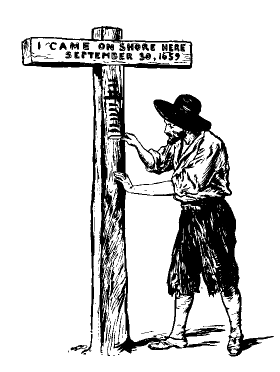
So I set up a large post by my door (поэтому я установил большой столб у двери). At the top of this post I cut in large letters these words (на верхушке столба я вырезал большими буквами эти слова; post — мачта, подпорка, свая, стойка, столб, кол, шест):
I CAME ON SHORE HERE (я высадился на берег здесь)
SEPTEMBER 30, 1659.
Every morning I cut a little notch on the side of the post under these words (каждое утро я вырезал зарубку на боку шеста под этими словами).
Every seventh notch was twice as long as the rest (каждая седьмая зарубка была в два раза длиннее других; rest — остаток, остальное), and this showed me that the day was Sunday (и это показывало мне, что этот день был воскресеньем).
Every thirtieth notch was longer and broader (каждая тридцатая зарубка была длиннее и шире). This showed me that a full month had gone by (это показывала мне, что прошел полный месяц).
It was thus I made my calendar (вот так я сделал календарь).
One morning I found, on counting up (одним утром я нашел, подсчитывая), that there were three hundred and sixty-five notches (что на столбе было 365 зарубок). I knew, therefore, that it was just one year since my landing (я узнал/понял, таким образом, что прошел уже год со времени моей высадки).
I sat in my castle and thought of the goodness of God in thus keeping me alive (я сидел в моем замке и думал о великодушии Бога /который/ так сохранил мне жизнь; to keep alive — сохранять в живых; goodness — доброта; великодушие) and safe in the midst of so many perils (и /к тому же/ посреди столь многих опасностей)
I humbled myself (я смирился; humble — смиренный), and thanked him for his many mercies (и поблагодарил его за его многие милости).
For twelve hours I tasted nothing (двенадцать часов я ничего не ел: «не пробовал»; to taste — попробовать /на вкус/, отведать). When, at last, the sun went down (когда, наконец, солнце зашло), I ate a biscuit and a bunch of grapes and went to bed (я съел печенье и гроздь винограда и лег спать: «пошел в постель»).
Having now been on the island a whole year (пробыв на острове уже целый год), I had learned that the seasons there were not the same as in England (я узнал, что времена года не были такими, как в Англии).
They were not to be spoken of as spring, summer, autumn, and winter (не приходилось говорить о весне, лете, осени и зиме). They were rather to be called the wet season and the dry season (скорее их нужно было называть дождливым и сухим сезонами). Indeed, there were two wet seasons and two dry seasons, in the year (в самом деле, было два влажных сезона = сезона дождей и два сухих сезона в году).
year ['jq:], since [sIns], account [q'kaunt], wreck [rek], neither ['naIDq], almanac ['O:lmqnxk], full [ful], month [mAnT], therefore ['DeqfO:], solemn ['sOlqm], peril ['perIl], autumn ['O:tqm]
I MAKE ME A CALENDAR
IT was now just one year since I was cast upon this lonely island. Do you wonder how I have kept an account of the time? I will tell you.
A few days after the ship wreck it came into my mind that I should lose track of the days and the seasons. For I had neither almanac nor notebook. It would be hard always to remember the days of the week and I might even forget when it was Sunday.
So I set up a large post by my door. At the top of this post I cut in large letters these words:
I CAME ON SHORE HERE
SEPTEMBER 30, 1659.
Every morning I cut a little notch on the side of the post under these words.
Every seventh notch was twice as long as the rest, and this showed me that the day was Sunday.
Every thirtieth notch was longer still and broader. This showed me that a full month had gone by.
It was thus I made my calendar.
One morning I found, on counting up, that there were three hundred and sixty-five notches on the post. I knew, therefore, that it was just one year since my landing.
I kept this day as a solemn fast.
I sat in my castle and thought of the goodness of God in thus keeping me alive and safe in the midst of so many perils.
I humbled myself, and thanked him for his many mercies.
For twelve hours I tasted nothing. When, at last, the sun went down, I ate a biscuit and a bunch of grapes and went to bed.
Having now been on the island a whole year, I had learned that the seasons there were not the same as in England.
They were not to be spoken of as spring, summer, autumn, and winter. They were rather to be called the wet season and the dry season. Indeed, there were two wet seasons and two dry seasons, in the year.
I SOW SOME GRAIN (я сею зерно)
THE first wet season began about the middle of February (первый влажный сезон начался примерно в середине февраля) and lasted till the middle April (и длился до середины апреля).
The first dry season (первый сухой сезон) began about the middle of April and lasted till the middle of August.
The second wet season (второй влажный сезон) began about the middle of August and lasted till the middle October.
The second dry season began about the middle of October and lasted till the middle of February.
I could not have kept track of these thing easily if it had not been for my calendar (я не смог бы вести учет этому так легко, если бы не мой календарь).
Just before the first rainy season began I was one day rummaging among the shelves in my cave (как раз перед тем, как начался первый сезон дождей, я одним днем копался среди полок в пещере; to rummage — тщательно разыскивать что-л.).
There I found the little bag (там я нашел небольшую сумку) that I had brought from the ship with some barley in it (которую я принес с корабля, с некоторым количеством ячменя в ней), as I have already told you (как я уже говорил вам).
I lifted it; it was almost empty (я поднял ее, она была почти пуста).
I looked inside (я заглянул внутрь). I saw nothing there but some dust and chaff (я не увидел там ничего, кроме пыли и мякины). The rats had been there (крысы побывали там), and had eaten the grains of barley (и съели зерна ячменя).
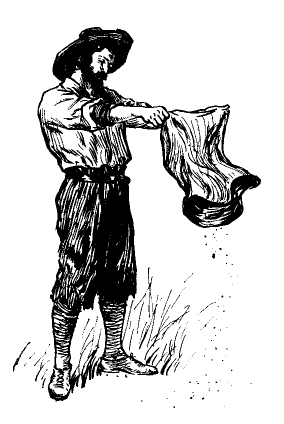
The bag would be useful for something else (сумка могла бы быть полезна для чего-нибудь другого). I took it outside and shook the dust and chaff upon he ground (я вынес ее наружу и вытряс пыль и мякину на землю). It was a sunny place (это было солнечное место), close by the great rock (близко к большой скале).
About a month after this (примерно /через/ месяц после этого), I saw that something green was starting to grow at that place (я увидел, что что-то зеленое начинало расти на том месте). I wondered what it was (я задался вопросом, что это было). It could not be grass (это не могла быть трава), for the stalks were larger and stronger (так как стебли были больше и крепче).
I had forgotten about the barley (я забыл о ячмене; to forget). But I took care that nothing should break the stalks down (но я позаботился, чтобы ничто не сломало стебли).
They grew fast (они росли быстро; to grow — расти), and were soon as high as my waist (и вскоре были такими высокими, как моя талия = стали мне по пояс). Then I was surprised to see ten or twelve heads of green barley come out (затем я был удивлен увидеть = с удивлением увидел, как появились десять или двенадцать головок = колосьев зеленого ячменя).
You cannot think how glad I was (вы не можете подумать = представить себе, как я был рад). I remembered, then, how I had shaken the bag of dust and chaff over that very spot (я вспомнил тогда, как я вытряс сумку пыли и мякины над тем самым местом; to shake — трясти).
But there was another surprise for me (но был и другой сюрприз/другая неожиданность для меня). I noticed in the wet ground (я заметил в мокрой земле) a little nearer the rock some other green plants (немного ближе к скале, несколько других зеленых растений). These were not so tall as the barley stalks (они не были такими высокими, как стебли ячменя), and they did not seem to be the same (и не казались быть тем же = и казалось, что это не ячмень).
I watched them for several days (я наблюдал за ними несколько дней). Then I saw that they were stalks of rice (затем я увидел, что они /эти ростки/ были стеблями риса). No doubt some grains of rice had been in the bag with the barley (без сомнения, несколько зерен риса было в сумке с ячменем), and had fallen out with the dust and chaff (и вывалились вместе с пылью и мякиной).
You may be sure that I took good care of the grain (можете быть уверены, я хорошо позаботился о зерне). As soon as the barley was ripe I harvested it (как только ячмень был созревшим = созрел, я собрал урожай; to harvest — собирать урожай). There was only a handful or two (это было всего лишь горсть или две); but I put it away where no rats could get to it (но я убрал его подальше, где никакие крысы не могли добраться до него). I wished to keep it safe and plant it again the next season (я хотел сохранить его и посадить вновь в следующем сезоне).
I did the same way with the rice (то же самое я проделал с рисом).
There was so little to begin with that it took a long time to grow a big crop (/его/ было так мало для того, чтобы начать /выращивать/ = пришлось начать со столь малого количества, что заняло долгое время вырастить большой урожай). It was not until the fourth harvest that I could keep some of the barley for bread (только с четвертым урожаем я смог сберечь/оставить немного ячменя для хлеба; until — до /какого-л. времени/).
I found that the best place to plant the grain was not on the hillside (я обнаружил, что лучшее место сажать зерно было не на склоне холма), but in a moist spot not far from my summer home (а во влажном месте недалеко от моего летнего дома).
One day, as soon as the wet season was at an end (однажды, как только влажный сезон закончился: «был при конце»), I made a visit to the country to see how my crops were growing (я совершил визит = поход вглубь острова, чтобы посмотреть, как растет мой урожай).
There I saw something that surprised me (там я увидел что-то, что поразило меня).
You will remember the fence that I built around my summer house (вы помните забор, который я построил вокруг моего летнего дома), or bower as I called it (или беседки, как я называл его). It was made of two rows of tall stakes, with brush between (он был сделан из двух рядов длинных кольев с ветками между /ними/).
Well, I now found that the stakes were still green (так вот теперь я обнаружил, что колья были все еще зелеными), and that long shoots or twigs were growing from them (и что длинные побеги, или ветки, росли на них). Some of these branches were already two or three feet long (некоторые из веток были уже два-три фута длиной).
This pleased me very much (это меня очень порадовало; to please — нравиться). I cut and trained the growing branches into just such shapes as I wished (я подрезал и согнул растущие ветки как раз в такую форму, как я хотел).
They grew very fast (они росли очень быстро; to grow — расти), and soon the whole fence was covered with green leaves (и вскоре весь забор был покрыт зелеными листьями). Then I trained the long branches toward the top of a pole which I set up in the center of my bower (затем я загнул длинные ветки к верхушке шеста, который я установил в центре беседки).
In a few months the whole inclosure was covered with a green roof (через несколько месяцев все огороженное пространство было покрыто зеленой крышей).
You cannot think how beautiful it was (вы не можете себе представить, насколько это было красиво). The place was shady and cool (место было тенистым и прохладным; shade — тень), the pleasantest spot one could wish to have (самое приятное место, /которое/ кто-либо мог желать иметь).
I did not know what kind of tree it was that grew in this wonderful way (я не знал, какой вид дерева это был, что рос таким удивительным способом). But I cut some more stakes of the same sort and carried them home to my castle (но я срезал несколько еще кольев этого же вида и принес их домой в мой замок).
I set these stakes in a double row (я воткнул эти колья в двойной ряд), about twenty inches outside of my first wall (примерно в двадцати дюймах снаружи от моей первой стены). In a few weeks they began to grow (через несколько недель они начали расти). They grew so fast that in two years they covered the whole space in front of my castle (они росли столь быстро, что через два года они покрыли все пространство перед моим замком).
They were not only handsome to look at (на них не только было приятно смотреть; handsome — красивый), but they helped to protect my castle (но они /к тому же/ помогали защищать мой замок).
February ['febru(q)rI], April ['eIpr(q)l], August ['O:g qst], October [Ok'tqubq], dust [dAst], chaff [tSQ:f], stalk [stO:k], surprised [sq'praIzd], notice ['nqutIs], several ['sev(q)r(q)l], cover ['kAvq], handsome ['hxn(d)sqm], protect [prq'tekt]
I SOW SOME GRAIN
THE first wet season began about the middle of February and lasted till the middle April. The first dry season began about the middle of April and lasted till the middle of August.
The second wet season began about the middle of August and lasted till the middle October.
The second dry season began about the middle of October and lasted till the middle of February.
I could not have kept track of these thing easily if it had not been for my calendar.
Just before the first rainy season began I was one day rummaging among the shelves in my cave.
There I found the little bag that I had brought from the ship with some barley in it, as I have already told you.
I lifted it; it was almost empty.
I looked inside. I saw nothing there but some dust and chaff. The rats had been there, and had eaten the grains of barley.
The bag would be useful for something else. I took it outside and shook the dust and chaff upon the ground. It was a sunny place, close by the great rock.
About a month after this, I saw that something green was starting to grow at that place. I wondered what it was. It could not be grass, for the stalks were larger and stronger.
I had forgotten about the barley. But I took care that nothing should break the stalks down.
They grew fast, and were soon as high as my waist. Then I was surprised to see ten or twelve heads of green barley come out.
You cannot think how glad I was. I remembered, then, how I had shaken the bag of dust and chaff over that very spot.
But there was another surprise for me. I noticed in the wet ground a little nearer the rock some other green plants. These were not so tall as the barley stalks, and they did not seem to be the same.
I watched them for several days. Then I saw that they were stalks of rice. No doubt some grains of rice had been in the bag with the barley, and had fallen out with the dust and chaff.
You may be sure that I took good care of the grain. As soon as the barley was ripe I harvested it. There was only a handful or two; but I put it away where no rats could get to it. I wished to keep it safe and plant it again the next season.
I did the same way with the rice.
There was so little to begin with that it took a long time to grow a big crop. It was not until the fourth harvest that I could keep some of the barley for bread.
I found that the best place to plant the grain was not on the hillside, but in a moist spot not far from my summer home.
One day, as soon as the wet season was at an end, I made a visit to the country to see how my crops were growing.
There I saw something that surprised me.
You will remember the fence that I built around my summer house, or bower as I called it. It was made of two rows of tall stakes, with brush between.
Well, I now found that the stakes were still green, and that long shoots or twigs were growing from them. Some of these branches were already two or three feet long.
This pleased me very much. I cut and trained the growing branches into just such shapes as I wished.
They grew very fast, and soon the whole fence was covered with green leaves. Then I trained the long branches toward the top of a pole which I set up in the center of my bower.
In a few months the whole inclosure was covered with a green roof.
You cannot think how beautiful it was. The place was shady and cool, the pleasantest spot one could wish to have.
I did not know what kind of tree it was that grew in this wonderful way. But I cut some more stakes of the same sort and carried them home to my castle.
I set these stakes in a double row, about twenty inches outside of my first wall. In a few weeks they began to grow. They grew so fast that in two years they covered the whole space in front of my castle.
They were not only handsome to look at, but they helped to protect my castle.
I MAKE A LONG JOURNEY (я предпринимаю длинное путешествие)
I HAD long wished to see the whole of my island (я уже давно желал увидеть весь мой остров: «целое моего острова»). So, one fine morning (так что, одним прекрасным утром), I set out to travel across to the other side of it (я пустился путешествовать через /него/ до другого берега).
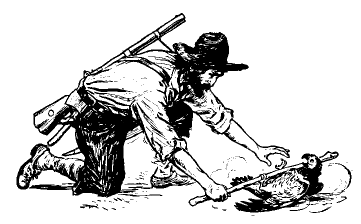
Of course I carried my gun with me (конечно, я нес мое ружье с собой). In my belt was my best hatchet (на ремне у меня был мой лучший топорик). In my pouch (в /патронной/ сумке) I had plenty of powder and shot (у меня было много пороха и дроби). In my pocket were two biscuits and a big bunch of raisins (в кармане было два печенья и большая горсть изюма; bunch — связка, пучок, пачка). My dog followed behind me (моя собака следовала за мной).
I went past my summer house (я прошел мимо летнего дома), or bower (или беседки), and toward evening came to a fine open place close by the sea (и к вечеру пришел на красивое открытое место близко к морю).
It was a beautiful sight (это был красивый вид). The sky was clear, the air was still (небо было ясным, воздух спокойным). The smooth waters (тихие воды; smooth — гладкий) stretched away and away toward the setting sun (тянулись вдаль и вдаль /по направлению/ к заходящему солнцу).
Far in the distance (далеко на расстоянии) I could see land (я мог видеть землю). I could not tell whether it was an island or some part of the mainland of America (я не мог сказать, был ли это остров или часть континента Америки). It was at least fifty miles away (она /земля/ была по меньшей мере в пятидесяти милях).
If it were the mainland (если бы это был материк), I felt quite sure (был совершенно уверен; to feel — чувствовать) that I would at some time or other see a ship sailing hither to it or from it (что когда-нибудь: «в какое-либо время или другое» я увижу корабль, плывущий сюда к нему или от него; hither — сюда). If it were an island (если это был остров), there might be savages (там могли быть дикари) whom it would not be safe for me to meet (которых для меня было бы небезопасно встретить). But it would do no good to worry my mind about such matters (не было смысла беспокоить мой ум /вопросами/ о подобных вещах: «материях»).
I found this side of the island much more beautiful than that where my castle was (я обнаружил, что эта сторона острова была намного красивее, чем та, где был мой замок).
Here were large, open fields, green with grass (здесь были большие, открытые поля, зеленые от травы = покрытые травой) and sweet with flowers (и красивы от цветов; sweet — сладкий; приятный). Here, too, were fine woods, with many strange trees and vines (здесь также были красивые рощи с множеством странных деревьев и вьющихся растений).
I saw many green parrots among the trees (я увидел много зеленых попугаев среди деревьев), and I thought how I would catch one and teach it to talk (и подумал, как бы мне поймать одного и научить его говорить).
After a great deal of trouble I knocked a young one down with my stick (после множества трудностей я сбил молодого /попугая/ палкой). He was a good fighter (он был хорошим бойцом; to fight — сражаться), and it was no easy matter to get him (и было не простым делом заполучить его). But at last I picked him up and put him in my bag (но в конце концов я подобрал его и положил в свою сумку).
He was not hurt (он не был ранен; to hurt — причинить боль; ранить; ушибить), and I carried him home (и я отнес его домой). It was a long time before I could make him talk (прошло много времени, прежде чем я заставил/научил его говорить). But at last he became a great pet (но в конце концов он стал прекрасным питомцем) and would call me by my name (и называл меня по имени). I shall have a funny story to tell about him after a while (я буду иметь смешную историю рассказать = я расскажу смешную историю о нем через некоторое время).
Besides parrots there were many other birds in the woods (кроме попугаев, там было много других птиц в лесу). Some of these were of kinds that I had never seen before (некоторые из них были видов, которых я никогда раньше не видел).
In the low grounds I saw some animals that looked like rabbits (на низких землях = в низинах я видел некоторых животных, которые выглядели как кролики). There were others that I took to be foxes (там были /и/ другие, которых я принимал за лис), but they were not such foxes as we have in England (но они были не такими лисами, какиеу нас в Англии).
I traveled very slowly around the island (я путешествовал очень медленно по острову), for I wished to see everything (так как хотел увидеть все). Often I did not go more than two miles in a day (часто я не проходил более двух миль в день).
At night I sometimes slept in a tree (ночью я иногда спал на дереве; to sleep — спать), while my dog watched below me (в то время как моя собака охраняла внизу). Sometimes I shut myself up in a little pen made by driving tall stakes into the ground (иногда я скрывался в маленьком загончике, сделанном посредством вбивания длинных палок в землю; to shut — закрывать, запирать, затворять; to shut up — плотно закрыть; забить, заколотить; запирать /что-л. где-л./; хранить; прятать; pen — небольшой загон /для скота, птицы/). I felt quite safe (я чувствовал себя вполне в безопасности; to feel — чувствовать), for nothing could come near me without waking me (так как ничто не могло приблизиться ко мне, не разбудив меня: «без того, чтобы разбудить меня»).
Along the seashore there were thousands of turtles (вдоль берега были тысячи черепах) and a great plenty of waterfowl (и множество водоплавающих птиц; fowl — птица; дичь).
I had no trouble to find all the food I needed (у меня не было трудностей с нахождением всей той еды, в которой я испытывал потребность). Sometimes I had a roast pigeon for dinner (иногда у меня был жареный голубь на обед), sometimes the juicy meat of a turtle (иногда сочное мясо черепахи; juice — сок), sometimes that of a goat (иногда /мясо/ козы). No king could have fared better (никакой король не мог бы поесть лучше; to fare — жить, поживать; питаться).
One day my dog caught a young kid (однажды собака поймала козленка). I ran and got hold of it (я побежал и схватил его; to get hold of smth. — схватить что-л.: «получить ухват/хватку»), and would not let him hurt it (и не позволил ей ранить его).
I had a great mind to take it home with me (у меня было большое желание взять его домой с собой). So I made a collar for it (поэтому я сделал для него ошейник), and led it along by a string which I had in my pocket (и отвел его на веревке, которая была у меня в кармане; to lead — вести).
It was quite wild (он был довольно диким) and did not lead well (и не велся хорошо = нелегко было его вести). It gave me so much trouble that I took it to my summer house and left it there (он доставил мне так много трудностей, что я отвел его в летний дом и оставил там; to leave — оставлять, покидать).
I then went home to my castle (затем я ушел домой в мой замок).
travel [trxvl], across [q'krOs], pouch ['pautS], sure ['Suq], knock [nOk], bird [bq:d], along [q'lON], fowl ['faul], pigeon ['pIGIn], juicy ['Gu:sI], collar ['kOlq], [trAbl]
I MAKE A LONG JOURNEY
I HAD long wished to see the whole of my island. So, one fine morning, I set out to travel across to the other side of it. Of course I carried my gun with me. In my belt was my best hatchet. In my pouch I had plenty of powder and shot. In my pocket were two biscuits and a big bunch of raisins. My dog followed behind me.
I went past my summer house, or bower, and toward evening came to a fine open place close by the sea.
It was a beautiful sight. The sky was clear, the air was still. The smooth waters stretched away and away toward the setting sun.
Far in the distance I could see land. I could not tell whether it was an island or some part of the mainland of America. It was at least fifty miles away.
If it were the mainland, I felt quite sure that I would at some time or other see a ship sailing hither to it or from it. If it were an island, there might be savages on it whom it would not be safe for me to meet. But it would do no good to worry my mind about such matters.
I found this side of the island much more beautiful than that where my castle was.
Here were large, open fields, green with grass and sweet with flowers. Here, too, were fine woods, with many strange trees and vines.
I saw many green parrots among the trees, and I thought how I would catch one and teach it to talk.
After a great deal of trouble I knocked a young one down with my stick. He was a good fighter, and it was no easy matter to get him. But at last I picked him up and put him in my bag.
He was not hurt, and I carried him home. It was a long time before I could make him talk. But at last he became a great pet and would call me by my name. I shall have a funny story to tell about him after a while.
Besides parrots there were many other birds in the woods. Some of these were of kinds that I had never seen before.
In the low grounds I saw some animals that looked like rabbits. There were others that I took to be foxes, but they were not such foxes as we have in England.
I traveled very slowly around the island, for I wished to see everything. Often I did not go more than two miles in a day.
At night I sometimes slept in a tree, while my dog watched below me. Sometimes I shut myself up in a little pen made by driving tall stakes into the ground. I felt quite safe, for nothing could come near me without waking me.
Along the seashore there were thousands of turtles and a great plenty of waterfowl.
I had no trouble to find all the food I needed. Sometimes I had a roast pigeon for dinner, sometimes the juicy meat of a turtle, sometimes that of a goat. No king could have fared better.
One day my dog caught a young kid. I ran and got hold of it, and would not let him hurt it.
I had a great mind to take it home with me. So I made a collar for it, and led it along by a string which I had in my pocket.
It was quite wild and did not lead well. It gave me so much trouble that I took it to my summer house and left it there.
I then went home to my castle.
I HARVEST MY GRAIN (я собираю мое зерно = мой урожай)
I CANNOT tell you how glad I was to get to my old house again (я не могу сказать = передать вам, как рад я был попасть в мой старый дом вновь) and lie down in my good hammock bed (и лечь в мою кровать-гамак).
I had been away for nearly a month (меня не было /здесь/ почти месяц; to be away — уходить, отлучиться; отсутствовать: «быть прочь»).
I was so tired from my long journey (так устал: «был таким уставшим» от длинного путешествия) that I stayed in my castle nearly a week (что я остался в замке почти на неделю).
While I was thus resting myself (пока я так отдыхал), I made a cage for my parrot (я смастерил клетку для попугая) which I named Poll (которого я назвал Попка; poll — стандартная кличка для попугая). He was very gentle for a parrot (он был очень послушным/смирным для попугая; gentle — /уст./ благородный; мягкий, добрый; послушный, смирный /обычно о животных/), and soon became very fond of me (и вскоре стал любить меня: «стал очень любящим меня/привязанным ко мне»; to become — становиться; fond of smb., smth. — любящий кого-л., что-л.).
Then I began to think of the kid (затем я начал думать о козленке) that I had left in my summer bower (которого я оставил в беседке). So I went with my dog to fetch it (поэтому я пошел со своей собакой забрать его).
I found it where I had left it (я нашел его там, где оставил его; to leave — оставлять, покидать). It had eaten all the grass inside of the fence (он съел всю траву внутри ограды) and was now very hungry (и был теперь очень голоден).
I gave it as much as it wished (я дал ему ее /травы/ столько, сколько он хотел), and then I tied the string to it to lead it away (а затем привязал веревку к нему, чтобы увести его). But there was no need of that (но в том не было нужды), for it was quite tame (потому что он был вполне послушным; tame — прирученный, одомашненный; укрощенный /о животных/).
It followed me everywhere (он следовал за мной всюду). It was very gentle and loving (он был очень добрым/смирным и любящим).
I had now a number of pets (теперь у меня было несколько: «число» домашних животных; number — число; a number — некоторое количество, несколько) and was no longer lonesome (и я больше не был одиноким).
My life was much happier (моя жизнь была намного счастливее) than it had been while I was sailing the seas (чем она была, когда я плавал по морям). I took delight in many things (я радовался многим вещам: «брал отраду во многих вещах»; delight — радость, отрада) that I had never cared for before (на которые ранее я никогда не обращал внимания/к которм прежде был равнодушен; to care for smb., smth. — заботиться о ком-л., чем-л.; проявлять интерес, испытывать любовь/привязанность к кому-л., чему-л.).
My barley and rice had grown well (ячмень и рис выросли хорошо; to grow — расти) and in another month would be ready to be harvested (и через месяц будут готовы к тому, чтобы быть собранными; harvest — урожай; to harvest — снимать урожай).
But one day I saw that some animals had been in the field (но однажды я увидел, что некоторые животные побывали в поле). Goats and rabbits had trampled upon the green stalks (козы и кролики потоптали зеленые стебли) and had eaten the long blades of barley (и поели длинные листья ячменя).
If things kept on this way I should soon lose my grain (если так будет продолжаться, я вскоре потеряю мое зерно).
There was nothing to be done but to build a fence or hedge around the field (ничего не оставалось делать, как только построить забор или устроить живую изгородь вокруг поля; hedge — /живая/ изгородь; ограда). This was easy, for the field was not large (это было легко, так как поле не было большим).
I drove tall stakes into the ground all around my growing crops (я вбил длинные колья в землю вокруг моего растущего урожая; to drive — гнать; вгонять, вбивать). These stakes were so close together (они были так близко вместе = друг к другу) that not even a rabbit could get between them (что даже кролик не мог пробраться между них).
Then I tied my dog near the gate of the little field (затем я привязал собаку у ворот маленького поля), so that he would bark whenever any animal came near (так, чтобы она бы залаяла, когда какое-либо животное приблизится; whenever — всякий раз когда; когда бы ни).
My grain was now safe from the beasts (мое зерно было = мои злаки были теперь в безопасности от зверей). It grew fast (оно росло быстро). The barley sent out large heads (ячмень выпустил большие головки = колосья) which soon began to ripen (которые скоро начали зреть).
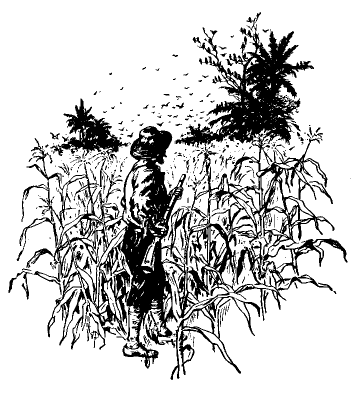
But now the birds came down in great flocks to rob me (но теперь птицы спускались большими стаями, чтобы грабить меня). They sat on the fence (они сидели на заборе), they flew among the stalks of grain (они летали между стеблями зерна; to fly — летать), they carried away all the ripe barley they could find (они уносили весь зрелый ячмень, который могли найти).
This troubled me very much (это беспокоило меня очень сильно). The most of the grain was still green (большая часть зерна была еще зеленой). But I feared that as soon as it ripened I should lose it all (но я боялся, что как только оно созреет, я потеряю его полностью).
I loaded my gun (я зарядил ружье) and went out to the field (и вышел в поле). There I saw the thieves (там я видел воров), sitting on the fence and watching me (сидящих на заборе и наблюдающих за мной). I was so angry (я был таким сердитым/раздраженным) that I fired right among them and killed three (что выстрелил прямо между ними и убил троих).
"Now I will show you how to steal my grain (сейчас я покажу вам, как воровать мое зерно)!" I cried.
I put up a long pole in the center of the field (я установил длинный шест в центре поля), and on top of it I hung the three dead birds (и на верхушке его повесил три мертвых птицы; to hang — вешать).
"This will I do to all that venture to come into my field (это я сделаю со всеми, кто решится зайти на мое поле)," I said.
Strange to say, this ended all my troubles (странно сказать, но это прекратило все мои горести). Not another bird came to that place so long as my scarecrows hung there (ни одна другая птица не приходила = не прилетала на это место, пока мои пугала висели там; scarecrow — пугало; to scare — пугать; crow — ворона). In fact, the birds went away from that part of the island, and I did not soon see another (на самом деле, птицы покинули эту часть острова, и я не скоро увидел другую = не скоро увидел других птиц).
thus [DAs], parrot ['pxrqt], delight [dI'laIt], lose [lu:z], angry ['xngrI], scarecrow ['skeqkrqu]
I HARVEST MY GRAIN
I CANNOT tell you how glad I was to get to my old house again and lie down in my good hammock bed.
I had been away for nearly a month. I was so tired from my long journey that I stayed in my castle nearly a week.
While I was thus resting myself, I made a cage for my parrot which I named Poll. He was very gentle for a parrot, and soon became very fond of me.
Then I began to think of the kid that I had left in my summer bower. So I went with my dog to fetch it.
I found it where I had left it. It had eaten all the grass inside of the fence and was now very hungry.
I gave it as much as it wished, and then I tied the string to it to lead it away. But there was no need of that, for it was quite tame.
It followed me everywhere. It was very gentle and loving.
I had now a number of pets and was no longer lonesome.
My life was much happier than it had been while I was sailing the seas. I took delight in many things that I had never cared for before.
My barley and rice had grown well and in another month would be ready to be harvested.
But one day I saw that some animals had been in the field. Goats and rabbits had trampled upon the green stalks and had eaten the long blades of barley.
If things kept on this way I should soon lose my grain.
There was nothing to be done but to build a fence or hedge around the field. This was easy, for the field was not large.
I drove tall stakes into the ground all around my growing crops. These stakes were so close together that not even a rabbit could get between them.
Then I tied my dog near the gate of the little field, so that he would bark whenever any animal came near.
My grain was now safe from the beasts. It grew fast. The barley sent out large heads which soon began to ripen.
But now the birds came down in great flocks to rob me. They sat on the fence, they flew among the stalks of grain, they carried away all the ripe barley they could find.
This troubled me very much. The most of the grain was still green. But I feared that as soon as it ripened I should lose it all.
I loaded my gun and went out to the field. There I saw the thieves, sitting on the fence and watching me. I was so angry that I fired right among them and killed three.
"Now I will show you how to steal my grain!" I cried.
I put up a long pole in the center of the field, and on top of it I hung the three dead birds.
"This will I do to all that venture to come into my field," I said.
Strange to say, this ended all my troubles. Not another bird came to that place so long as my scarecrows hung there. In fact, the birds went away from that part of the island, and I did not soon see another.